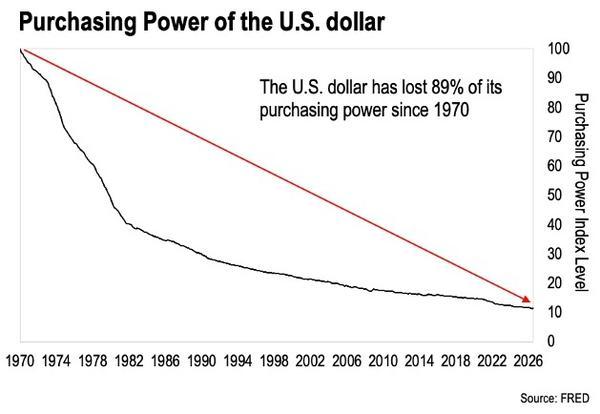
What we’re looking at here is the Federal Reserve’s own data. It shows that one dollar in 1970 is now worth about eleven cents in terms of what it can purchase. Said another way, it takes roughly nine dollars today to buy what one dollar bought in 1970.
But it wasn’t just American citizens who got the short end of the stick this time.
International Outrage
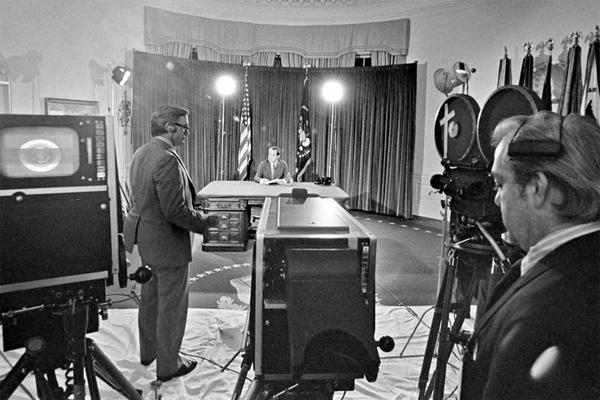
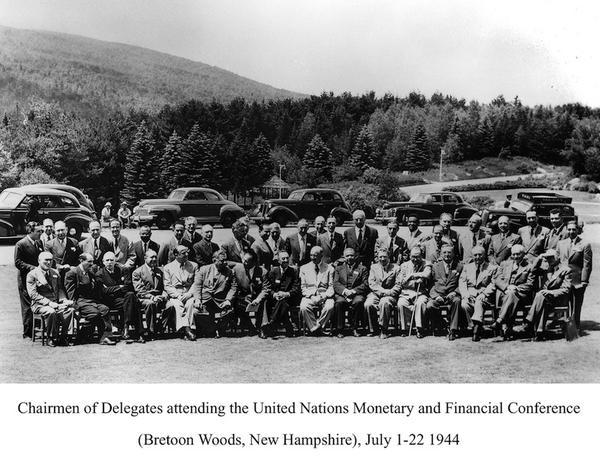
The reaction to Nixon’s speech abroad was fury. Here was the sitting US president unilaterally ending the Bretton Woods agreement and telling the world that they could no longer get their gold back.
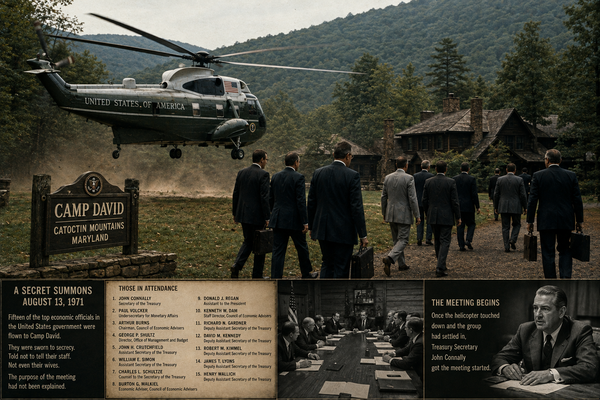
And Treasury Secretary Connally handled the diplomacy exactly as we might expect from the man who had driven the decision. Meeting with the finance ministers of the countries whose reserves had just been converted into unbacked paper, he reportedly said something to the effect of: "The dollar is our currency, but it's your problem now.”
To be fair, it was a true statement.
The rest of the world had accumulated dollars because the system required them to, but those dollars were convertible into gold upon demand. That was supposed to be the deal. But now the dollars were unbacked, and there was no recourse. It seems Connally saw no reason to pretend otherwise.
There was some jostling and some attempts to reconstitute a fixed global monetary arrangement in the wake of what became known as the Nixon Shock. But nothing stuck.
So for over fifty years now, we’ve been living with a global monetary system that consists of currencies that are essentially floating abstractions. That is to say, each country’s currency has constantly fluctuated in value relative to others. So it was that the foreign exchange (forex) trading market came to be.
If you were to ask a forex trader how much the Euro is worth, he might tell you $1.15 – or whatever the exchange rate happened to be at the time. And that’s technically true. As I write, one Euro is worth $1.15.
But what does that actually mean? What is $1.15 worth?
To answer that question, we must compare the US dollar to something tangible. And that’s why gold was so integral to the system for so long. Not only was it a check on excessive spending, but it was also an objective measuring stick.
In 1971, an ounce of gold cost $35. As I write this, an ounce of gold costs around $4,600.
But here’s the thing – gold didn't get more valuable. Nothing about the physical metal has changed.
What changed is the measuring stick. It takes about 131 times as many dollars to buy the same gold coin today as it did in 1971.
And if we compared the US dollar’s purchasing power to other items – houses, cars, groceries – we’ll see a similar story. Nearly everything costs a lot more today than it did fifty years ago.
But again, that’s not because everything got more expensive. It’s because the US dollar has lost an enormous amount of purchasing power. And that’s the direct result of running our economy on a fiat monetary system.
The lesson is structural, and it's the same lesson we’ve been tracking throughout this essay series. Every mechanism we've traced was justified by an emergency...
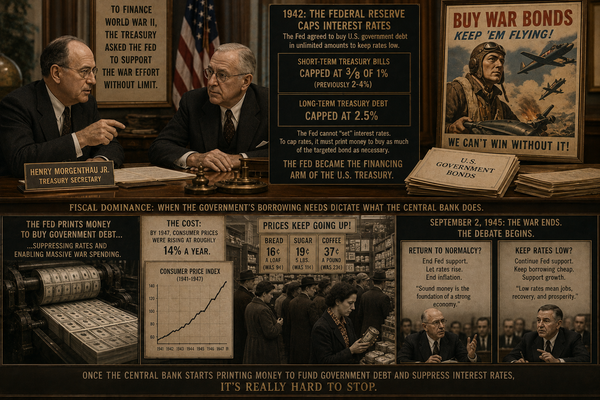
The Federal Reserve was created in 1913 to prevent financial panics... The Trading with the Enemy Act was amended in 1933 to save the banking system... American gold was then confiscated that same year to shore up the banking system that was saved... The Banking Act of 1935 was passed because the Fed failed at its one job... Interest rates were artificially suppressed in the 1940s to finance a war... The gold reserve requirement was removed in 1968 to finance “guns and butter”... The gold window was closed in 1971 to stop a run on the US Treasury’s gold reserves.
Every sequence in this monetary chain of events had a real problem behind it. But I would suggest that each event simply compounded the underlying problems without addressing the root cause. And by doing so, each “solution” paved the way for a future emergency.
That's the pattern. The emergency ends, but the mechanism stays. And each mechanism becomes the foundation on which the next one is built... and so it was that we drifted farther and farther away from the vision of America’s founders.
Alexander Hamilton wanted a national credit system that would drive productivity and create an economically independent American republic. Meanwhile, Thomas Jefferson wanted a decentralized agrarian economy that would be insulated from corruption. Both wanted sound money and a system that would raise standards of living for Americans – even if they differed on what that system should look like.
By August of 1971, we were oceans away from those visions. And since there was no longer an external limit on how much credit could be created, and no mechanism at all requiring that the credit be productive, the central bank machine morphed into something that was capable of financing anything but accountable to nothing.
What followed over the next five decades would destroy the purchasing power of the US dollar, thus making it very difficult for Americans to maintain a middle-class lifestyle.
It’s easy to see that in the data. What’s harder to see is how this dynamic systematically ate away at American culture.
More on that to come...
-Joe Withrow
P.S. At this point we’ve traced the American System’s history from 1790 to present day, though what we’ve had since 1913 is much closer to the old British system that both Hamilton and Jefferson despised. We’ll explore this dynamic more over the course of another three or four essays to conclude the series.
In addition, we are working behind the scenes on something special for the first week of October. More on that soon...

No comments:
Post a Comment