 A Message From Crypto 101 Media Dear Investor, If you want to build real wealth in 2026, read to the end. My track record speaks for itself:
- KDA: 17,556%
- PRE: 3,900%
- OCEAN: 2,650%
- ALBT: 1,933%
Every single one was called to our community before the big move happened… And right now, I'm making my next big call. It's a coin trading under $1.00… one most investors have never even heard of. But the world's largest bank is already building on it. It has a burn mechanism wired directly to institutional usage… meaning the more the big money uses it, the more rare it becomes. And its biggest supply cut in history happened earlier this year… but most haven’t caught on yet. This is the exact setup where every one of my biggest winners was born. See my #1 coin now… while it's still under $1 → To your massive success,
Bryce Paul
Crypto 101
This Month's Exclusive Story
Viking's Obesity Edge May Be Staying Power, Not Weight LossWritten by Chris Markoch. Publication Date: 9/23/2026. 
Key Points
- Viking Therapeutics shares jumped 36% after new data showed patients on VK2735 kept most weight loss when switched to less frequent dosing.
- The maintenance edge could differentiate Viking from Eli Lilly and Novo Nordisk, though rivals Amgen and Pfizer are also pursuing monthly dosing options.
- Phase 3 VANQUISH trial readouts are expected in 2027, and Viking's roughly $502 million in cash may not cover a full commercial launch.
- Special Report: The $15 Gold Fund That Pays Up to $1,152/Month
Viking Therapeutics (NASDAQ: VKTX) stock jumped 36% on Sept. 22. The catalyst was new maintenance data for VK2735, its GLP-1/GIP obesity candidate. The data showed that patients maintained most of their weight loss after switching from weekly injections to dosing every other week or once a month. Investors shouldn't oversimplify this as just another win in the obesity drug market. The study wasn't about how much weight patients lost. It was about how long they could keep the weight off and how often they needed an injection to do so.
That distinction matters because the GLP-1 market is maturing. The category is crowded, and pricing is under pressure. Eli Lilly (NYSE: LLY) and Novo Nordisk (NYSE: NVO) are competing most directly on peak weight loss. Competing on that data point alone is a losing game for a clinical-stage company. Viking may be able to take a different path. An edge in weight-loss maintenance means Viking's candidate could offer an additional benefit beyond simply being "a cheaper Zepbound." That raises a question for investors: Is less frequent dosing a real commercial edge, or is it just a nice feature in a market where Lilly already dominates? What the VK2735 Data Actually ShowRoughly 180 adults with obesity took a weekly dose of VK2735 or a placebo for 21 weeks. Weight loss ranged from about 16% to 19%, compared with roughly 0% for the placebo group. Patients were then moved to less frequent dosing for 12 weeks. Viking's headline numbers showed that patients maintained 97% and 90% of their weight loss, respectively. However, investors need to examine the details. Each figure came from a single dose group of about a dozen patients. The combined averages tell a clearer story. Patients switched to every-other-week dosing maintained 90% of their weight loss, while those on monthly dosing maintained 85%. Patients switched to placebo maintained 61%. Gastrointestinal side effects during maintenance were similar to those reported with placebo. Is Less Frequent Dosing a Real Edge?The current best-selling GLP-1 drugs are weekly injections. Lilly's Zepbound and Novo's Wegovy both require a shot every week. Both companies now also sell daily pills. Novo's Wegovy pill was approved in December, and Lilly's Foundayo followed in April. Lilly has already staked a claim on maintenance. In its ATTAIN-MAINTAIN trial, patients switched from Wegovy to daily orforglipron. Over 52 weeks, they maintained all but 0.9 kilograms of their prior weight loss. Zepbound switchers regained about five kilograms. With VK2735, Viking offers a third option: a monthly shot. For patients who dislike daily pills or weekly injections, that's a real convenience. Better adherence can make weight loss more durable. Payers may also favor a lower-dose maintenance regimen if it reduces the cost per patient. However, Viking is likely to face competition sooner rather than later. Amgen (NYSE: AMGN) has MariTide, while Pfizer (NYSE: PFE) is pursuing monthly dosing with berobenatide, which it acquired through Metsera. While monthly dosing is a differentiator today, it may be table stakes by the time VK2735 reaches the market. What Phase 3 Still Has to ProveThe maintenance study was short and small. A 12-week trial says little about what happens after a year or more. It also enrolled otherwise healthy adults rather than the higher-risk patients who drive much of the market. The VANQUISH Phase 3 program addresses some of those limitations. VANQUISH-1 enrolled about 4,500 adults with obesity, while VANQUISH-2 enrolled about 1,000 adults with obesity and type 2 diabetes. Both are 78-week trials, with readouts expected in 2027. However, VANQUISH tests weekly dosing. Maintenance regimens will be studied in extension trials expected to begin in late 2026 or early 2027. Viking also plans to begin an oral Phase 3 program this quarter. How Does Viking Pay for the Road to Approval?Viking ended June with about $502 million in cash. Management says that amount funds operations into 2028. That should cover the VANQUISH readouts, but it likely won't cover a full commercial launch. Building manufacturing capacity and a sales force to compete with Lilly and Novo is expensive. Viking has three realistic paths. It can raise equity, thereby diluting shareholders. It can partner with a larger drugmaker. Or it can be acquired. Takeover talk has followed Viking for years. Pfizer's roughly $10 billion Metsera deal, won in a bidding war with Novo, demonstrates big pharma's appetite for obesity assets. But that's a scenario, not a prediction. Viking has so far advanced VK2735 on its own. VKTX Stock Technical Analysis: Can the Rally Break $43?Analyst sentiment for VKTX remains strong. The consensus price target of $99.22 implies upside of 150%. However, context is important: That price target was established before the latest VK2735 results. Analysts understand that it will still be some time before the Phase 3 study is completed, and longer still before the drug receives commercial approval. 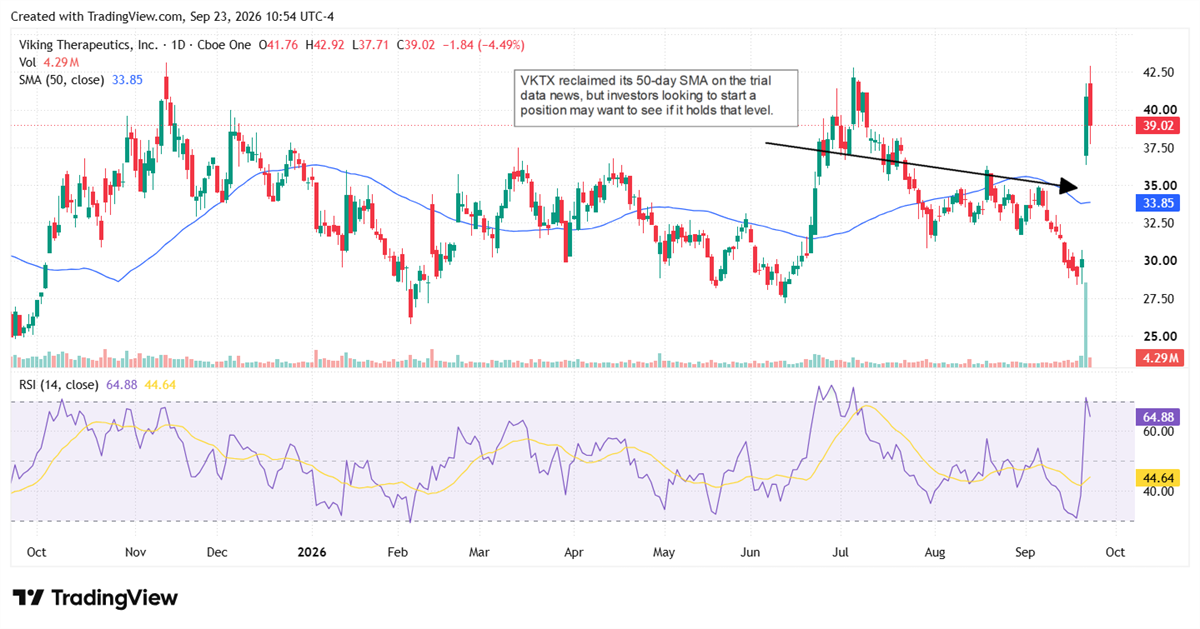
The chart supports that cautious outlook. VKTX gapped up from around $30 to above $40 on the news. Volume was the highest in the past year, confirming strong buying interest. The stock also reclaimed its 50-day simple moving average (SMA), which is now near $34. However, the rally is running into a familiar ceiling. The $42.50 to $43 zone capped the stock in November 2025 and again in July. On Sept. 23, shares touched $42.92 before reversing lower. Momentum is cooling as well. The relative strength index (RSI) approached overbought territory at 70 before easing to around 65. The 50-day SMA is also still sloping downward. A pullback toward the $34 to $37 range would not be surprising. A close above $43 would signal a true breakout. Viking Stock: A GLP-1 Durability Play, Not a Zepbound RivalThe GLP-1 trade has matured. Being "another obesity drug" is no longer enough to win investor dollars. Viking's maintenance data point to a different identity: the durability and convenience option. Whether that identity holds depends on the Phase 3 results and how quickly monthly rivals advance. For now, the rally reflects a narrative shift more than a proven commercial edge. Investors should price it accordingly.
© 2026 Boardwalk Flock LLC. All Rights Reserved.
2382 Camino Vida Roble, Suite I
Carlsbad, CA 92011, United States
The advice and strategies contained herein may not be suitable for your situation. You should consult with a professional where appropriate.
Readers acknowledge that the authors are not engaging in the rendering of legal, financial, medical, or professional advice. The reader agrees that under no circumstances Boardwalk Flock, LLC is responsible for any losses, direct or indirect, which are incurred as a result of the use of the information contained within this, including, but not limited to, errors, omissions, or inaccuracies.
Results may not be typical and may vary from person to person. Making money trading digital currencies takes time and hard work. There are inherent risks involved with investing, including the loss of your investment. Past performance in the market is not indicative of future results. Any investment is at your own risk.
© 2026 Boardwalk Flock LLC. All Rights Reserved.
2382 Camino Vida Roble, Suite I
Carlsbad, CA 92011, United States
The advice and strategies contained herein may not be suitable for your situation. You should consult with a professional where appropriate.
Readers acknowledge that the authors are not engaging in the rendering of legal, financial, medical, or professional advice. The reader agrees that under no circumstances Boardwalk Flock, LLC is responsible for any losses, direct or indirect, which are incurred as a result of the use of the information contained within this, including, but not limited to, errors, omissions, or inaccuracies.
Results may not be typical and may vary from person to person. Making money trading digital currencies takes time and hard work. There are inherent risks involved with investing, including the loss of your investment. Past performance in the market is not indicative of future results. Any investment is at your own risk.
. |


No comments:
Post a Comment