 A Message From Porter & Company Something strange is happening to your money. It wasn't voted on. It wasn't debated in the Senate. And most Americans have no idea it's even taking place but… President Trump is replacing the U.S. dollar. Not with crypto. Not with a digital currency. Something far bigger than that – and it's already been signed and sealed in the back rooms of D.C., ready to be issued by the U.S. Treasury. Bypassing every legal and political channel under the guise of "national security," Trump has enacted this total money reset using a landmark executive order (1421). Whether you’re a Democrat or Republican, whether you support this new money or not, it doesn't matter. Soon, every U.S. citizen will be forced to use Trump's New Dollar to fill their gas tank, buy groceries, and pay medical bills. Which is why I've produced a critical new documentary laying out exactly what Trump's New Dollar means for your savings, your investments, and your family's financial future. Detailing three important steps you can take today to prepare – including the name of a core band of assets connected to Trump’s initiative that could surge as a result. As you’ll see in my briefing, the last time America reset its money like this – under Richard Nixon’s presidency in the 1970s – it created one of the greatest wealth divides in the history of our nation. On one side, it minted an average of 1,300 new millionaires a day for over half a century. And on the other… the folks left behind, drowning in debt, with no idea how to use America’s new money to create wealth. As Trump rolls out his new dollar, the question is: Which side will you be on? 
Good investing,
Porter Stansberry PS. If you’re wondering what Trump’s new money will look like, when it will be issued, what it means for your investments and why it could be front page news on December 14 – all of those questions are answered in my briefing.
Special Report
Cologuard Is Working—So Why Isn’t Abbott Stock?By Chris Markoch. Posted: 10/22/2026. 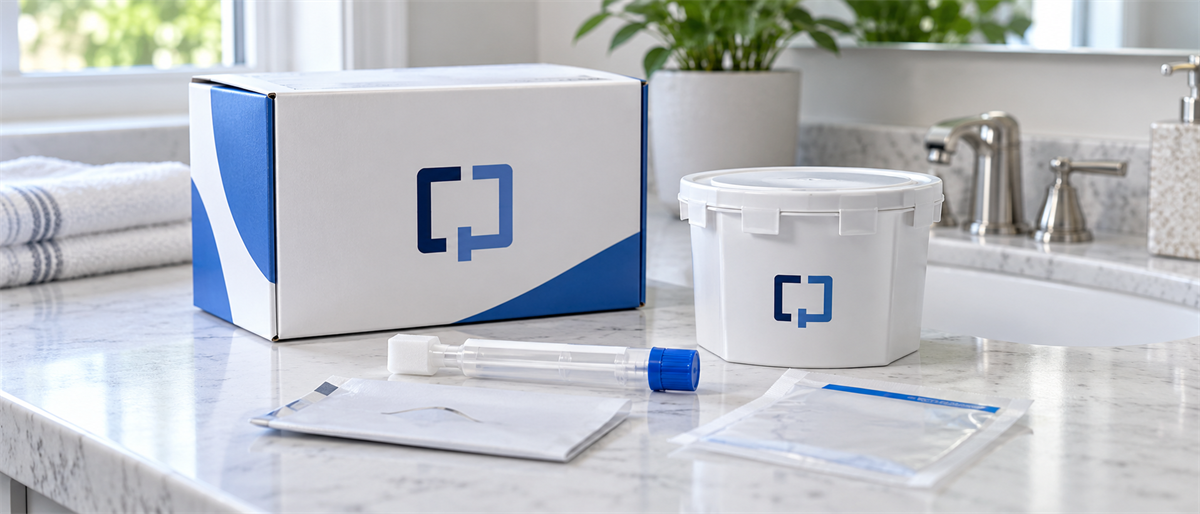
Key Points
- Abbott Laboratories shares fell about 4% after third-quarter results beat revenue expectations but failed to impress investors seeking stronger growth.
- The company announced plans to separate its Nutrition business, home to brands like Similac and Ensure, into an independent public company by the end of 2027.
- Abbott lowered its full-year comparable sales growth outlook to about 6% while narrowing adjusted EPS guidance to a range of $5.50 to $5.55.
- Special Report: I've seen this movie before (last time: 17,556%)
Abbott Laboratories (NYSE: ABT) delivered its third-quarter earnings report on Oct. 21. The stock dropped about 4% in early trading, as the results were merely solid at a time when investors wanted something spectacular. Revenue of $13.01 billion edged out expectations of $12.99 billion. Sales rose 14.5% on a reported basis, boosted by the Exact Sciences acquisition, and 7% on a comparable basis, with Exact Sciences included in both periods.
On the bottom line, adjusted earnings per share (EPS) of $1.42 were in line with expectations. Both revenue and EPS, however, increased year over year (YOY). In Q3 2025, revenue was $11.37 billion and adjusted EPS was $1.30. That works out to 9% earnings growth, and CEO Robert Ford noted that both sales and earnings accelerated compared with the first half of the year. Where the Growth Is Coming FromThis continues a story that began last quarter, when Abbott began to see revenue growth following its acquisition of Exact Sciences. That growth, which includes the colon cancer screening tool Cologuard, continued in Q3. However, management was cautious in its guidance for future acceleration, which could be putting pressure on the shares. Diagnostics sales jumped 46.7% to $3.31 billion on a reported basis, but rose only 6.4% on a comparable basis. The Cancer Diagnostics segment, which houses the former Exact Sciences businesses, generated $968 million in sales, up 13.8% on a comparable basis. Cologuard led the way, supported by Exact Sciences’ precision oncology and international businesses. Medical Devices remained Abbott’s largest segment, with sales of $5.83 billion, up 7.8% on a comparable basis. Electrophysiology grew in the mid-teens, or the high teens when excluding left atrial appendage (LAA) products. Management called this the early stage of a growth-acceleration phase for the business. Why Investors Are Selling the NewsOne reason for the drop in Abbott's stock is that the company's earnings report came on Oct. 21, the morning after SpaceX (NASDAQ: SPCX) delivered a strong earnings report. That sent money flowing back into the technology sector and left blue-chip names like ABT vulnerable to selling. Abbott also used its earnings release to announce plans to separate its Nutrition business into an independent, publicly traded company. That business is home to brands such as Similac, PediaSure, Pedialyte, Glucerna and Ensure. The company says the separation will be structured as a tax-free distribution to shareholders and is expected to be completed by the end of 2027. Over the long term, the move could sharpen Abbott’s focus on medical devices and diagnostics. In the short term, it adds complexity for investors trying to value the company. But Abbott's earnings report also gave investors more immediate reasons for concern. The company lowered its full-year comparable sales growth outlook to about 6%, down from its prior range of 6.5% to 7.5%, citing headwinds in diabetes care and electrophysiology. Even so, management expects fourth-quarter sales growth to accelerate to just above 8%. Abbott also narrowed its full-year adjusted EPS guidance to $5.50 to $5.55, from $5.45 to $5.60, leaving the midpoint essentially unchanged. However, even at the low end of that guidance, adjusted EPS would be up nearly 7% from $5.15 in 2025. That’s still below the $5.55 to $5.80 range the company issued in January, before dilution from the Exact Sciences deal was factored in. Investors may also be worried that Abbott's 2027 outlook will fall short of expectations, given management's plans to issue conservative guidance in January. ABT Needs to Reclaim Its Moving AveragesLooking at its chart, ABT is range-bound between about $83 and $117. The top of that range is now a well-defined double top. The near-term concern is that the current swing failed well short of that level. The 50-day moving average is flattening above a 200-day moving average that’s still sloping downward, so the August golden cross may be close to unwinding. Investors will want to closely watch the 50- and 200-day simple moving averages. If ABT can reclaim those levels on strong volume, a case could be made for a cup-and-handle formation. Until then, the near-term levels to watch are $95–$96, the October low, and $106, where the latest rally was rejected. 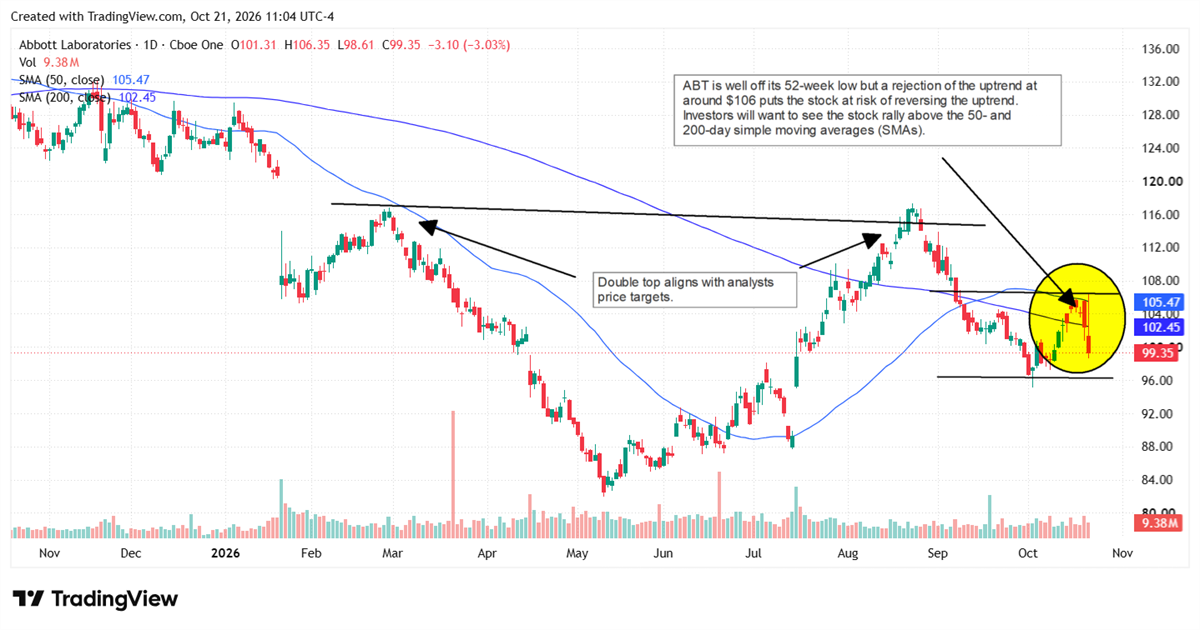
Analysts May Provide the JuiceAs of this writing, the Abbott Labs analyst forecasts on MarketBeat show a consensus price target of $118.88. That implies a gain of about 20% and also aligns with the double top the stock formed in March and August. That 20% gain would be in addition to the stock's dividend, which yields 2.5%. ABT is also a dividend king with a 54-year streak of increasing its dividend payout. The dividend is well supported by the company's projected cash flow. Income investors don’t need to worry about the spinoff, either. Abbott expects the combined dividend paid by Abbott and the new Nutrition company to equal Abbott’s dividend at the time of the separation. . |


No comments:
Post a Comment