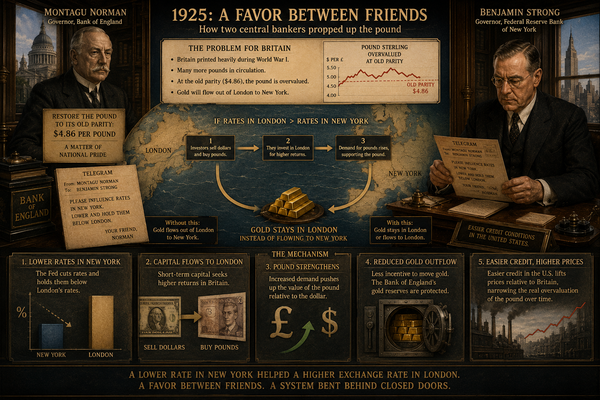
Needless to say, Strong obliged his friend. He followed through with a series of rate cuts throughout the summer of 1924, reducing interest rates in New York by 1.5% so that the US dollar would be artificially weakened relative to the pound in an effort to prop it up.
Of course, Strong didn’t say that’s what he was doing.
In public announcements and official explanations, he emphasized purely domestic reasons for the rate cuts. He talked about the mild business slowdown in 1924, continued heavy gold imports that were swelling bank reserves, the need to relieve pressure on member banks that were still heavily indebted to the Federal Reserve, and he emphasized the need to support American agriculture and commodity exporters with lower rates.
Only in private correspondence and in carefully worded internal memoranda did Strong acknowledge that he was working to help the pound sterling recover so that Britain could safely return to the gold standard. But he never elaborated on the fact that doing so required devaluing the dollar to support the pound.
Despite Strong’s efforts, the market proved more savvy than expected.
Britain did return to gold at $4.86 in April 1925 without an immediate collapse, but the underlying overvaluation never disappeared. British goods remained expensive on world markets, exports stayed weak, and unemployment hovered at painfully high levels. The Bank of England was forced to keep interest rates higher than it wanted just to defend the parity.
And while gold did not drain out of London in one catastrophic rush, it systematically leaked away in fits and starts whenever interest-rate differentials or other pressures turned against London.
By the summer of 1927 the strain had become acute again. Norman could not raise British interest rates further without risking domestic upheaval. At the same time, economic strength had been pulling capital into the United States to seek investment opportunities.
This prompted Strong to cut the Fed's discount rate by another 50 basis points (0.5%) in 1927 to continue propping up the British pound. But that decision was much harder to justify.
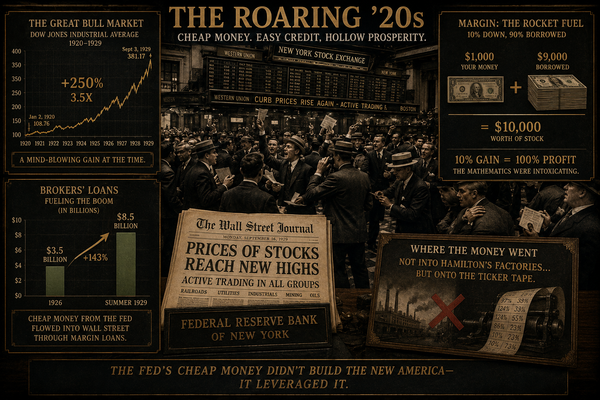
It had become clear that US interest rates were already too low, and Strong’s “easy money” policies had fed a growing speculation in the American stock market. Share prices were climbing rapidly, brokers’ loans were expanding, and a number of officials (including inside the Federal Reserve) were already uneasy about the speculative fever on Wall Street.
Strong himself knew that his 1927 rate cut would pour more fuel on the fire. He privately likened it to giving the market “a little coup de whisky”.
This made then-Secretary of Commerce Herbert Hoover furious. To those paying attention, it had become clear that Strong’s actions were not primarily in service of the American economy.
Strong pressed on regardless.
To him, international cooperation among central bankers was more important than domestic political criticism. That, and he was a loyal friend to Montagu Norman.
As a result, two of the most important monetary policy decisions of the 1920s — the monetary easing of 1924 and 1927 — were shaped in large part by the desire to keep US interest rates low enough to support Britain’s return to, and maintenance of, the gold standard at an overvalued parity.
These moves were driven primarily by Strong at the New York Fed, in close private consultation with Norman. There was limited effective oversight from the Federal Reserve Board in Washington.
And it was all possible because a group of conspirators sold their central banking structure to America by positioning it as the “Federal Reserve” – implying that it would serve as a monetary reserve that would protect Americans from the periodic financial panics that had plagued them previously.
The Machine, Turned On
In the last several installments of this series, we traced how the Federal Reserve came to be — the blueprint Paul Warburg carried over from Europe, the secret gathering on Jekyll Island in 1910, and the three-piece legislative package of 1913 that installed a European-style central bank and an income tax in a country that didn’t want either.
When we left off, President Wilson had just signed the Federal Reserve Act two days before Christmas in 1913. That installed the machine... and it’s never been turned off since.
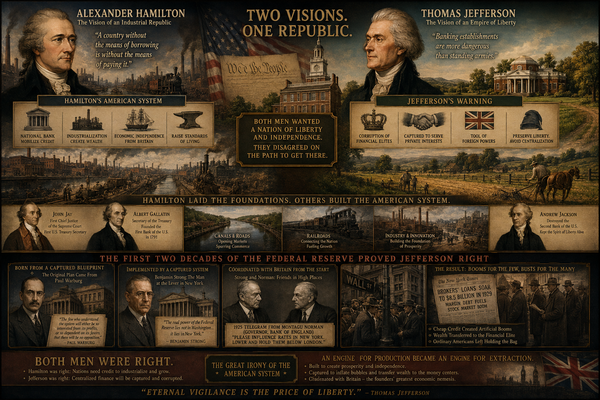
Now, if we go back to the beginning of this series, we’ll remember that Alexander Hamilton chartered the First Bank of the United States way back in 1791. That was a central bank... but it wasn’t one that we would recognize today.
Hamilton was adamant that the American financial system would run on sound money backed by specie (gold and silver), not money that could be created ex nihilo. He also believed very strongly in the principle of productive credit – the idea that bank credit should mostly be used to finance productive activity, not speculation or luxury spending.
Hamilton chartered the First Bank of the United States to be the vehicle that would ensure American credit would be funneled towards productive ventures – factories, infrastructure, farms, and the like.
And because the system ran on sound money, that credit was based on real savings. Thus, American credit wasn’t a tool of monetary policy – no such thing existed with the First Bank of the United States. Instead, it was a tool for driving productivity forward.
It’s certainly debatable how effective the national bank was at enshrining the principle of productive credit in the United States. It’s also debatable whether such an institution was needed.
What’s not debatable, however, is the fact that Hamilton’s central bank was markedly different from the system designed on Jekyll Island and based on European-style central banking. Indeed, the Federal Reserve was designed specifically to create an end-run around strict sound money requirements.
The idea of an “elastic currency” was at the heart of the design. The term refers to credit that could be created out of nothing, with some constraints at first, whenever the men at the controls decided the financial system needed extra liquidity.
What’s more, the system hammered out on Jekyll Island had little interest in the principle of productive credit. In fact, its elastic currency created the exact opposite effect – as we’ll see in just a few minutes.
So when the Federal Reserve machine turned on and the new elastic currency began flowing, the only question was: where would it go?
Hamilton had an answer for where bank credit should go — toward productive activity. But the Federal Reserve’s answer was: wherever the men closest to the money spigots want it to go.
In the 1920s, the men standing closest to the money spigots were not factory owners in Ohio or wheat farmers in Kansas. They were financiers in New York... and so the new money poured into Wall Street.
The Cheap Money Decade
Throughout the 1920s, under Benjamin Strong's steady hand, American money stayed cheap. That is to say, interest rates were kept relatively low and credit remained readily available for much of the decade.
These easy money policies supported a rapid expansion of business and consumer spending, but they also made it easy for large amounts of credit to flow into financial speculation, particularly on Wall Street.
To be fair, the historical record suggests that Strong genuinely believed in what he was doing. He was one of the men who met on Jekyll Island to get the central bank started. And he genuinely believed that the Fed should cooperate with the central banks of Europe. He was, by most accounts, smart, principled, and sincere.
So this doesn’t appear to be a man intent on sabotaging the American economy. But Strong’s apparent sincerity doesn’t make up for what happened next...
By cutting rates and engaging in easy money policies, Strong set the Cantillon Effect in motion. And the New York financiers who got their hands on America’s new elastic currency first used their good fortunes to engage in rampant speculation in the US stock market. Apparently they were not familiar with Hamilton’s principle of productive credit, either.
I suspect many of us have heard the term Roaring ‘20s before. And perhaps we’ve heard of the great bull market on Wall Street — the seemingly endless rise in stock prices that came to symbolize the decade’s exuberance and excess.
The problem is, the excesses of the Roaring ’20s were not the result of a purely organic productivity boom, as Hamilton expected his American System to create. To the contrary, it was the result of the Fed’s cheap money meeting the machinery of Wall Street.
The Dow Jones Industrial Average closed at 108.76 on the first day of trading in 1920. At its peak in September 1929, the Dow hit 381.17. That represents a gain of roughly 250%, or 3.5x. That was a mind-blowing investment gain at that time.

No comments:
Post a Comment