A Message From Porter & Company
I never thought I’d see this again…
I thought what happened 25 years ago was a once- in-a-lifetime event… but how wrong I was… because a quarter of a century later it’s happening again… and it’s about to upend everything.
For those who understand what’s unfolding, I believe this could be one of the greatest wealth-building phenomena of their lives.
But for those who bury their head in the sand… this change threatens to wipe out years of investment returns.
Here’s the full story:

25 years ago, I started telling friends, family, and anyone who would listen about an unprecedented societal shift that was barreling down on us.
I’d discovered that a new technology was about to unleash massive, almost unimaginable, changes in America.
I likened the impact to that of the railroad boom… the Industrial Revolution… and the rise of personal computing.
At the time, I was working as an investment analyst for an elite research group, but my colleagues and bosses refused to listen to me.
No matter what I said, they simply would not acknowledge the sands shifting beneath their feet.
The legendary Dr. Kurt Richebacher – one of the world’s leading Austrian economists – even called me and my ideas “radical.”
But I was certain this new technology would trigger a transformation that was simply unfathomable to most people and those on the frontier could reap financial returns unlike any the world had ever seen before.
So, I decided to put my entire career – not to mention every cent I had – on the line to spread the story myself.
I left my job as a research analyst, went home to my third-floor apartment in one of Baltimore’s worst neighborhoods, and with a borrowed laptop I wrote my first major financial prediction
In a report that was read by more than 100,000 people… I explained how the endless miles of new fiber optic cables being laid was creating a new railroad across America.
And that I believed this new “railroad” was going to upend the telecommunications industry and pave the way for a new internet economy.
I also warned it would decimate some of America's most dominant companies like AT&T.
At the time, this was an outlandish idea, with analysts calling AT&T “dominant”, “unstoppable”, and “the giant that no other company can topple.”
But those who were willing to open their minds to my so-called “radical” ideas were not only able to sell these companies before they collapsed…
They also had the chance to get in early on the firms that would go on to command this new internet economy:
Amazon, Adobe, Qualcomm, SunMicrosystems, Uniphase, Texas Instruments, and many others.
While these are household names now, when I first recommended them in the late ‘90s, they were complete unknowns.
Since then, long-term readers will know that I’ve issued a number of other predictions – and while I’m not always right – many of them have come to pass.
Now, I’m coming forward with a new prediction that I believe could be the most important financial and economic story of the next several years.
Both for the good and the bad.
Because as I recently told my subscribers:
“This is the largest infrastructure build-out in America since the railroad boom. You know this will change your life and the lives of all Americans, in many ways.
You know fortunes will be made, fortunes measured in trillions of dollars.
But what you don’t know is: most investors are about to lose everything.”
I’m not talking about quantum computing, augmented reality, or the blockchain. I’m talking about the second wave of artificial intelligence.
You see, right now, there is a new railroad being built.
Hundreds of billions of dollars a year are going into AI data centers – computers the size of cathedrals, drawing electricity measured in gigawatts, rising out of farmland in Ohio, Wyoming, and Texas.
But just as we saw during the railroad boom and the fiber-optic boom, the "builders" are going to get completely crushed by their own infrastructure costs.
Worse yet because this colossal infrastructure build is triggering an efficiency shock that is driving the cost of compute down to near zero… the margins of major software and AI tech darlings could collapse.
So the question is not who is building the data centers. The question is: Which industry can absorb almost unlimited, near-free computing power and still defend its prices?
We have found the answer.
It’s a completely abandoned sector of the market that represents the largest computational puzzle on earth.
More importantly, it is the only industry where the government hands you a legal, federally enforced monopoly to protect your product for decades.
I believe this sector is about to absorb the capex of the AI boom, and it could be among the best-performing sectors of the stock market… the next Mag7.
I’ve recorded a new step-by-step broadcast outlining exactly what is happening, and exactly where this capital is rotating.
During the broadcast, I even give you the name and ticker symbol of my #1 large-cap stock to buy right now for this second wave.
So click here to watch my Ignition Point event immediately.
Good investing,
Porter Stansberry
Just For You
Drone Stocks Have Burned Investors—Are These 4 Different?
Authored by Chris Markoch. Posted: 10/21/2026.
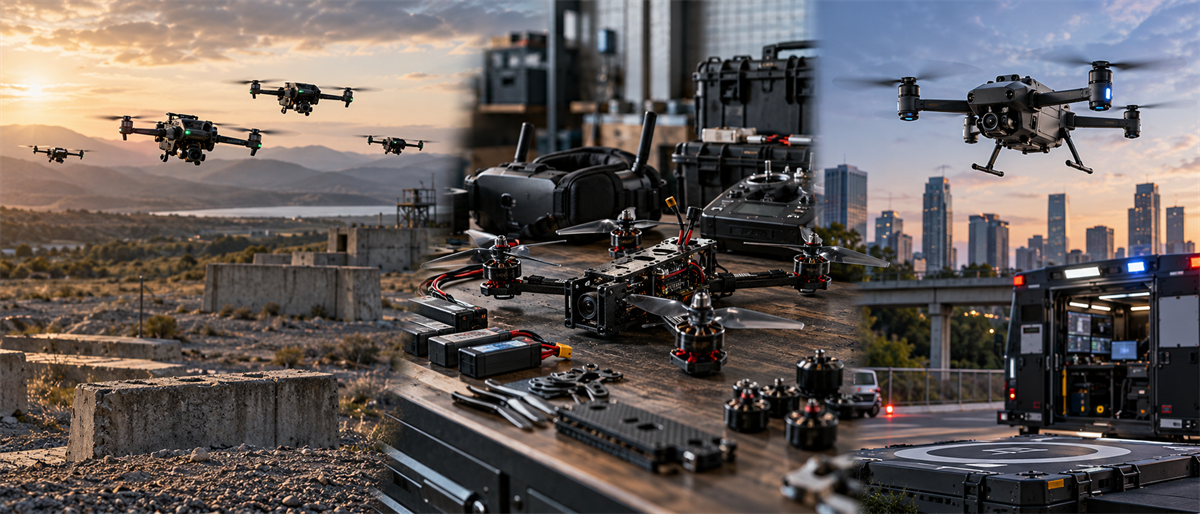
Key Points
- Drone stocks have broadly declined in 2026 as U.S. government spending lagged expectations and new executive orders reshaped the competitive landscape for manufacturers.
- Despite steep declines in names like Kratos and AeroVironment, analysts maintain Moderate Buy or Buy ratings on several drone-related stocks with significant upside price targets.
- The article highlights four stocks, Axon, AeroVironment, Swarmer, and Unusual Machines, as alternative ways to invest in the drone industry's components, software, or counter-drone technology.
- Special Report: Elon Musk… A Total Fraud?
Drone stocks have left many investors underwater. The REX Drone ETF (NASDAQ: DRNZ) is down approximately 23% this year. Some individual names, such as Red Cat (NASDAQ: RCAT), are down much more. Investors who haven't already taken a loss are wondering whether they'll ever recoup their investment.
One option is to stay the course, betting that future growth is a matter of when, not if. Another is to look at companies that make components rather than finished products. But first, it's important to understand the state of the drone industry.
Drone Dominance Is Complicated
Drone stocks began to soar in June 2025, when President Donald Trump signed an executive order titled "Unleashing American Drone Dominance." It doesn't get more bullish than that. The U.S. was going all in on domestic drone manufacturing.
But spending by the U.S. government hasn't materialized as expected. And now, the government is taking steps to limit foreign competition in the drone space.
That effort stems from a second executive order signed by President Trump, titled "Restoring American Airspace Sovereignty." The U.S. government, the drone industry's largest customer, is now also directly shaping the competitive landscape.
Why Drone Stocks Answer to Their Biggest Customer
What's happening in the drone trade is similar to, but different from, the "regulate AI" debate. In that case, some of the same companies creating and refining the technology are calling for regulation. In the case of drone manufacturers, the calls for regulation are coming from their largest customer: the U.S. government, specifically the Pentagon.
That's terrible news for pure-play drone stocks like Kratos (NASDAQ: KTOS), which is down over 47% in 2026. But there's still hope for the drone trade if you look at where the money is flowing. Here are four stocks to consider.
Axon: A Counter-Drone Stock Hiding in Plain Sight
Axon Enterprise Inc. (NASDAQ: AXON) is best known for products such as TASERS and body cameras in the public safety space.
However, the company also has a significant presence in the drone sector, including in the counter-drone space, where demand is expected to grow.
Revenue from the company's Dedrone platform exceeded $100 million in Q2 2026. That was a key contributor to the company's total quarterly revenue of more than $804 million, a 35% year-over-year (YOY) increase.
AXON shares are down about 30% in 2026, but the decline seems to be driven more by higher component and memory costs. Demand remains solid.
AXON carries a consensus Moderate Buy rating and a consensus price target of $707.07.
AeroVironment: A Drone Leader Priced for Bad News
AeroVironment Inc. (NASDAQ: AVAV) is the closest thing the drone trade has to a blue chip. Its Switchblade loitering munitions and Puma reconnaissance drones are already in the field. The BlueHalo acquisition added counter-drone, space, and electronic warfare capabilities.
None of that has protected the stock. AVAV opened 2026 at $241.89 and now trades near $118, a drop of more than 51%. That’s a steeper decline than Kratos.
But this looks more like a perception problem than a fundamentals problem. AeroVironment reported fiscal 2027 first-quarter earnings of 59 cents per share on Sept. 9, far exceeding the consensus estimate of 22 cents per share. Revenue grew 5.7% YOY. That’s not explosive growth, but the business isn’t broken.
The company is also looking beyond Washington. In mid-October, it signed non-binding agreements with partners in Spain and Taiwan to support local production and sustainment. That diversifies its customer base just as U.S. spending is in question.
Analysts are cautious, not bearish. AVAV carries a consensus Moderate Buy rating from 26 analysts and a consensus price target of $225.80.
Swarmer: A High-Risk Bet on Drone Swarm Software
If drones are the hardware, autonomy software is the brain. That’s where Swarmer Inc. (NASDAQ: SWMR) plays. Its platform lets a single operator coordinate large groups of drones. The company says its software has supported more than 100,000 combat missions in Ukraine since April 2024.
This is the most speculative name on the list. Swarmer went public in March and traded as high as $31 per share on March 17. Since then, the stock has fallen roughly 70%. Q2 revenue was just $216,413, against a net loss of $7.3 million. It's also important to note that Swarmer is based in Ukraine and may not benefit from future U.S. defense spending.
So why consider it? First, its software is vendor-agnostic. Swarmer doesn't need to win a hardware contract; it can run on top of whichever platform does. Its SkyKnight licensing deal recently expanded to $3.9 million. It has also partnered with Oak Grove Technologies to bring swarming to a platform built for U.S. Special Operations.
Second, Swarmer is buying scale. In September, it agreed to acquire Ukrainian ground robotics maker Ratel Robotics for up to $224 million in cash and stock. Ratel has secured $86 million in contracts this year. The stock plunged on dilution fears after the announcement.
Wall Street isn't buying the story yet. Only one analyst covers SWMR, and that analyst rates it a Sell. Investors buying here are betting on execution, not current numbers.
Unusual Machines: Picks and Shovels for Drone Makers
Unusual Machines Inc. (NYSEAMERICAN: UMAC) is the purest expression of the components strategy. The company makes NDAA-compliant motors, cameras, flight controllers, and other parts for drone makers. As Washington squeezes out foreign suppliers, domestic component makers become harder to replace.
The numbers back that up. Q2 revenue came in at $16.72 million, crushing analyst estimates of $9.2 million. That was a 687% YOY increase. Enterprise customers accounted for about 95% of sales.
Management is tempering near-term expectations, though. It’s targeting $12 million to $14 million in Q3 revenue while it installs a high-speed motor line. The Q4 target jumps to $25 million. Neither figure is formal guidance, so the Nov. 5 earnings report will be a key test.
UMAC is up about 30% in 2026, the only stock on this list in positive territory. But it’s well off its 50-day high of $34.06. That pullback gives investors a second chance. UMAC carries a consensus Buy rating from six analysts. The consensus price target of $37 implies significant potential upside.
. |