 A Message From Golden Portfolio Look at what's happened to these seven gold miners: MAG Silver — up 56.6%
Reunion Gold — up 71.9%
Calibre Mining — up 107.7%
Probe Gold — up 166.7%
Rupert Resources — up 177.9%
Loncor Gold — up 181.8%
G2 Goldfields — up 1,228.6% These weren't lucky picks or lottery tickets. Every one of them moved for the same reason — and it's a reason you can see coming. Go here to see the pattern behind all seven. Each of these was a small gold miner sitting on assets a major wanted. And one by one, the majors came and bought them. Now here's the part that matters: all seven were in my portfolio before the buyouts happened. Not seven picks out of hundreds. Seven names, all held ahead of the acquisition — because the same signal flagged every one of them. Once you understand what the majors are forced to do, spotting the next target stops being luck and starts being pattern recognition. Here's why that pattern isn't slowing down — it's accelerating. The major gold miners have a problem. Their own production is shrinking. Every ounce Barrick or Newmont pulls out of the ground makes their remaining mine worth a little less — a gold mine is a shrinking asset in slow motion. At the same time, the majors are sitting on the most cash they've ever held, thanks to today's gold prices. So a major has exactly two options: watch its output shrink until it's out of business… or use that record cash to buy the best small miners and replace what it's losing. That's not a choice. It's survival. Which means the buyouts don't stop — they keep coming, one after another, until the best small assets are gone. And here's what that looks like from the outside, if you own one of those small miners before the major comes knocking: You go to bed owning a small gold company. Overnight, a major announces it's buying that company — at a premium. You wake up, and your shares are worth 40%… 67%… even 79% more than when you closed your laptop the night before. No chart to watch. No trade to time. The value reprices instantly, while you sleep. That's already happened to all seven companies above — every one of them in my portfolio before it did. The only question left is which small miners are next — the ones with the grade, the cash flow, and the assets the big players actually need. My name is Garrett Goggin, CFA, CMT. My readers had the chance to hold all seven of those names before the majors bought them — and it's why Porter Stansberry recently called me: "THE most knowledgeable gold investor in the world." Go here to see the three names I believe are next in line to get bought. Best, Garrett Goggin, CFA, CMT
Lead Analyst and Founder, Golden Portfolio
This Week's Featured Content
3 Space Stocks to Watch as SpaceX Reshapes the Launch MarketAuthored by Jeffrey Neal Johnson. Originally Published: 9/25/2026. 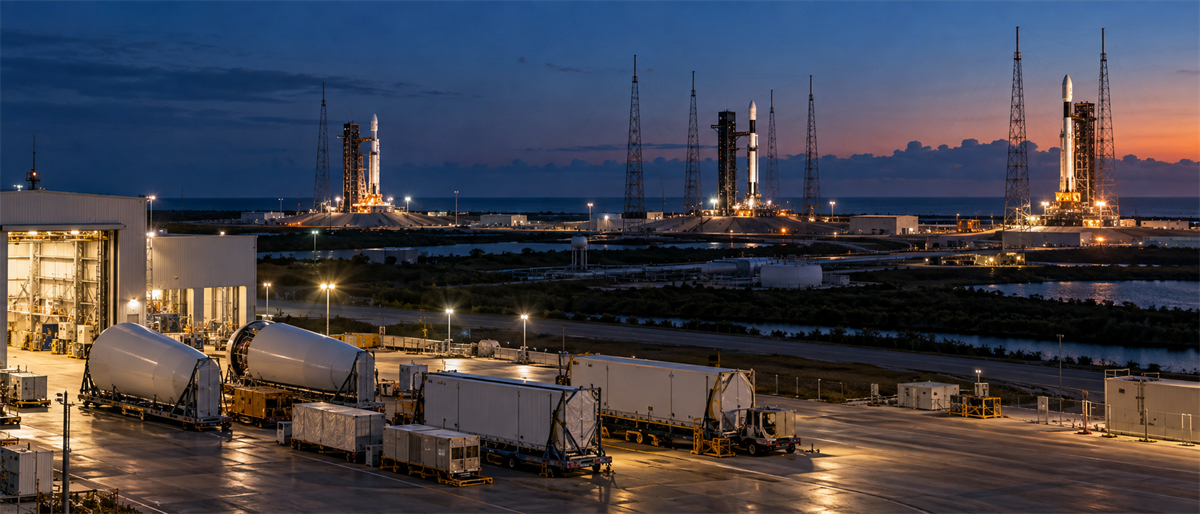
Key Points
- SpaceX's plan to end shared Falcon 9 missions after 2028, driven by Starlink's heavy capacity use, is tightening orbital launch supply and raising prices.
- Independent launchers like Rocket Lab and Firefly Aerospace are capturing displaced demand through growing backlogs, new facilities, and premium-priced launch contracts.
- Satellite operators such as Planet Labs face rising launch costs and margin pressure, though cash reserves may help them withstand higher capital expenditures.
- Special Report: Bezos… DOOMED?
For years, the commercial space economy operated on a predictable assumption: getting hardware into orbit was becoming cheaper. That calculus changed abruptly when SpaceX (NASDAQ: SPCX) indicated it would stop selling shared Falcon 9 missions beyond 2028. With its Starlink internet constellation now consuming approximately 79% of Falcon 9 capacity, SpaceX is prioritizing internal deployment over third-party logistics. While the surface-level explanation is standard corporate consolidation, the underlying reality points to a supply shock. Orbital launch capacity is shifting from a widely available commodity to a heavily constrained asset. This structural change creates a clear divide for investors analyzing the sector. Launch providers now hold substantial pricing power, while satellite operators that rely on purchased launch services face escalating capital expenditures. The current launch landscape shows a closing window of opportunity for independent hardware builders and growing financial risk for businesses caught on the wrong side of the payload fairing. Payload Pain: Tracking the 2028 Falcon Squeeze
SpaceX recently raised its standard rideshare rates to approximately $7,000 per kilogram. This provides immediate evidence that the capacity squeeze is already inflating costs, well ahead of the 2028 shared-mission cutoff. SpaceX has a market capitalization of about $1.93 trillion and generates approximately $18.67 billion in annual sales. A recent Nasdaq-100 rebalancing doubles the index weighting for SpaceX, forcing index funds to buy billions of dollars in shares and highlighting institutional confidence in the company's pricing power. When a single provider controls most commercial lift capacity, a policy change ripples across the entire supply chain. The sudden evaporation of third-party rideshare availability forces satellite operators to seek alternative transportation, creating an overflow of demand for a limited number of operational rockets. In the aerospace sector, demand does not simply wait for supply to catch up. Satellites in low Earth orbit experience atmospheric drag and radiation degradation, requiring constant replenishment to maintain coverage. For companies that sell data from space, pausing launches is rarely an option. This dynamic forces operators to accept higher launch prices, shifting economic leverage directly into the hands of the few companies capable of reaching orbit. Ignition Sequence: Launchers Grabbing Market ShareIndependent launchers are moving quickly to monetize this bottleneck. Rocket Lab USA (NASDAQ: RKLB) stands out as a primary beneficiary, with a record backlog approaching $2.36 billion. Rocket Lab currently commands a market capitalization of approximately $42.5 billion, supported by second-quarter revenue of $234.1 million, up 62% year over year. As SpaceX steps back from the shared market, Rocket Lab is securing early manifests for its upcoming medium-lift Neutron rocket at $50 million to $55 million per launch, without needing to offer significant discounts to attract payload operators. Execution remains the gating factor. Management is targeting pad delivery for the Neutron rocket around the fourth quarter of 2026, meaning actual commercial launches will likely extend into 2027. Rocket Lab is insulated by predictable government revenue as it scales, anchored by a recent $266 million U.S. Space Force contract extending through 2028. Firefly Aerospace (NASDAQ: FLY) is similarly scaling its physical infrastructure to capture orphaned payloads. Firefly Aerospace recently inaugurated a new cleanroom in Cedar Park, Texas. The expansion effectively quadruples its manufacturing footprint, enabling the simultaneous assembly of up to 12 lunar landers and orbital vehicles. The fundamentals show physical readiness, even as Firefly Aerospace trades around $22, a deep discount to its August 2025 initial public offering price of $41 to $43. Recent quarterly revenue surged approximately 659% year over year, and Firefly Aerospace reported an earnings-per-share loss of 42 cents, narrower than the 50-cent consensus estimate. Backed by institutional investors such as BlackRock, which holds a 3.68% stake, Firefly Aerospace is positioning itself to convert the industry's capacity squeeze into tangible revenue visibility. Burning Up on Reentry: Operator Margins Under PressureThe buy side of the launch market paints a different financial picture. Satellite operators require continuous orbital access to maintain and upgrade their constellations. As rideshare options evaporate and dedicated launch prices rise, these operators face direct threats to their unit economics. Planet Labs PBC (NYSE: PL) exemplifies this vulnerability. Planet Labs topped the latest quarterly estimates with a 58.2% jump in year-over-year revenue, reporting earnings per share of 2 cents. However, Planet Labs operates with a substantial net margin deficit of approximately -95.13%, recording recent net income of negative $246.86 million. Expanding its constellation to serve commercial and government clients requires frequent, reliable launches. Higher transportation costs translate directly into higher capital expenditures, delaying Planet Labs' path to profitability. Planet Labs has a critical defensive moat in the form of liquidity. Recent filings show Planet Labs maintaining approximately $865 million in cash and short-term investments. This provides a substantial operational runway to absorb higher transportation costs without requiring immediate dilutive financing. Caution remains evident among insiders, as highlighted by executive Robert Schingler's sale of more than 52,000 shares in mid-September 2026, alongside bearish short interest. Investors evaluating satellite operators should weigh this margin compression against their available cash buffers to determine whether they can weather the pricing storm. The Starship Shadow: Clocking the Supply Shock WindowThe core question for this trade is how long independent launchers' pricing power will last. The 2028 shared-mission cutoff creates a defined window of scarcity, but SpaceX is concurrently developing its next-generation Starship vehicle. Once Starship is commercially ready, it could flood the market with low-cost lift capacity, effectively erasing the bottleneck. Until Starship achieves a regular commercial cadence, the supply constraint is real. Legacy launchers have a few years to secure long-term agreements at premium rates, while satellite operators must navigate higher costs and manage their balance sheets carefully. Investors may want to monitor the execution timelines for vehicles such as Rocket Lab USA's Neutron and Firefly Aerospace's Alpha rocket, as production delays could limit their ability to fully capitalize on the current supply shock. Those evaluating the space sector should consider how each launcher balances immediate constraints with the eventual introduction of heavier-lift alternatives. . |


No comments:
Post a Comment