
A Message From Behind the Markets
Dear Friend,
I'm giving you a free stock pick today.
It's not Tesla. It's not SpaceX.
It's the little-known company Elon pays every time he builds anything.
Every Tesla. Every Starlink dish. Every AI satellite he sends up.
Elon doesn't own the chip inside them. He licenses it. From this one company.
And he just filed to launch 1,000,000 satellites.
That could mean a 100X bigger bill.
Dylan believes this stock takes off December 8th.
See today's free stock pick here >>
The Buck Stops Here,
Kelly Maguire
Behind the Markets
P.S. You can own it with a few clicks in any brokerage account. Just don't wait past December 8th.
Get the pick before December 8th here >>
Just For You
NVIDIA's Earnings Were Strong, But Can the Next CEO Keep the Momentum Going?
Submitted by Thomas Hughes. Date Posted: 11/18/2026.
Key Points
- NVIDIA's third-quarter revenue more than doubled year over year, while Vera Rubin generated nearly $20 billion in its first production quarter.
- Management raised its fiscal 2028 revenue growth outlook to 75% and reiterated plans to use its substantial share repurchase authorization.
- Jensen Huang's departure and NVIDIA's sharp stock price correction leave leadership and valuation risks in focus despite strong earnings.
- Special Report: Your 401(k) and IRA run on systems you can't control
NVIDIA’s (NASDAQ: NVDA)Q3 fiscal year 2027 (FY2027) earnings report, guidance and conference call mark a turning point for AI investors. While risks and concerns remain, the Huang era has effectively ended AI’s speculation phase, and the Q3 results point to the next phase: execution. That means converting massive backlogs into cash flow, turning plans into data centers and capitalizing on investments that, for NVIDIA, span its ecosystem and future revenue opportunities.
The primary takeaway from the release is momentum, reflected in NVIDIA’s results, guidance and longer-term forecasts. As interim CEO Colette Kress pointed out, the long-term 2028 guidance is higher than the prior forecast on a larger base. This represents a significant increase in the forward outlook, validating signals from other companies critical to the AI sector.
Oracle (NYSE: ORCL), Micron (NASDAQ: MU), Astera Labs (NASDAQ: ALAB) and Credo Technologies (NASDAQ: CRDO) are just a few companies signaling strength, with guidance pointing to acceleration over the next few quarters. More importantly, these companies are inflecting or on track to reach positive cash flow and profitability—perhaps the single most important factor for investors.
NVIDIA Signals Multi-Year Roadmap Intact: Vera Rubin Sales Are Ramping
NVIDIA’s Q3 results continued the trend, outperforming MarketBeat’s consensus estimates by several percentage points, driven by strength in Data Centers and AI. The Data Center business led, growing more than 100% year over year (YOY), but it wasn’t the only area of strength: Edge Computing also posted solid growth of about 42%. Within the business, Vera Rubin added nearly $20 billion in sequential revenue, representing the fastest product ramp in company history, following Blackwell.
As strong as revenue is, margins and guidance are the market’s key triggers. Margins improved, supporting ample cash flow and balance-sheet improvements that backstop NVIDIA’s investment and spending commitments. Guidance and management commentary point to a steady, stable market in which customers remain committed to product cycles. Q4 FY2027 revenue is expected to grow nearly 91% YOY, ahead of consensus expectations, following Q3’s strong results. Looking further ahead, Kress and her team expect approximately 75% growth in fiscal 2028, up 5 percentage points from the prior forecast.
Board Signals Confidence, Shifting Focus With Buyback Authorization
Buyback plans are a signal for investors to watch, and they are strengthening alongside the business. The board authorized an additional $150 billion in September, bringing total available funds to more than $225 billion—a sign of confidence in the company’s cash flow. That $225 billion is relatively small compared with NVIDIA’s market cap, but it is enough to reduce the share count, and further repurchases are expected. Executives remain committed to directing free cash flow toward capital returns, net of investments, which some analysts expect to slow. Speculation is that the company will scale back its aggressive investment cycle after securing its multi-year growth trajectory and direct more cash flow to capital returns, particularly buybacks.
Balance-sheet and cash-flow highlights support the case for accelerating buybacks. Cash is up nearly threefold year to date, while investments, receivables, inventory, current assets and total assets have also increased, outpacing liabilities and driving equity despite the company’s investments. Liabilities remain low relative to equity and cash flow, which is forecast to improve sequentially in fiscal 2028. Q3 operating cash flow topped $48 billion, leaving more than $43 billion in free cash flow after capital spending. Quarterly capital returns topped $28 billion, up more than 120% year over year, leaving ample room for future increases.
Initial analyst responses reflect cautious optimism and reinforce NVDA’s upside potential. MarketBeat tracks one downgrade to Hold and a price-target reduction, though the revised target is close to the consensus target. Half a dozen analysts reaffirmed their ratings and targets, offsetting those moves. The takeaway is that upside potential has diminished, but only slightly: a consensus of 60 analysts rates the stock Moderate Buy and forecasts about 70% upside as of mid-November.
NVIDIA at Bottom? Signs Say Yes, Too Soon to Be Sure
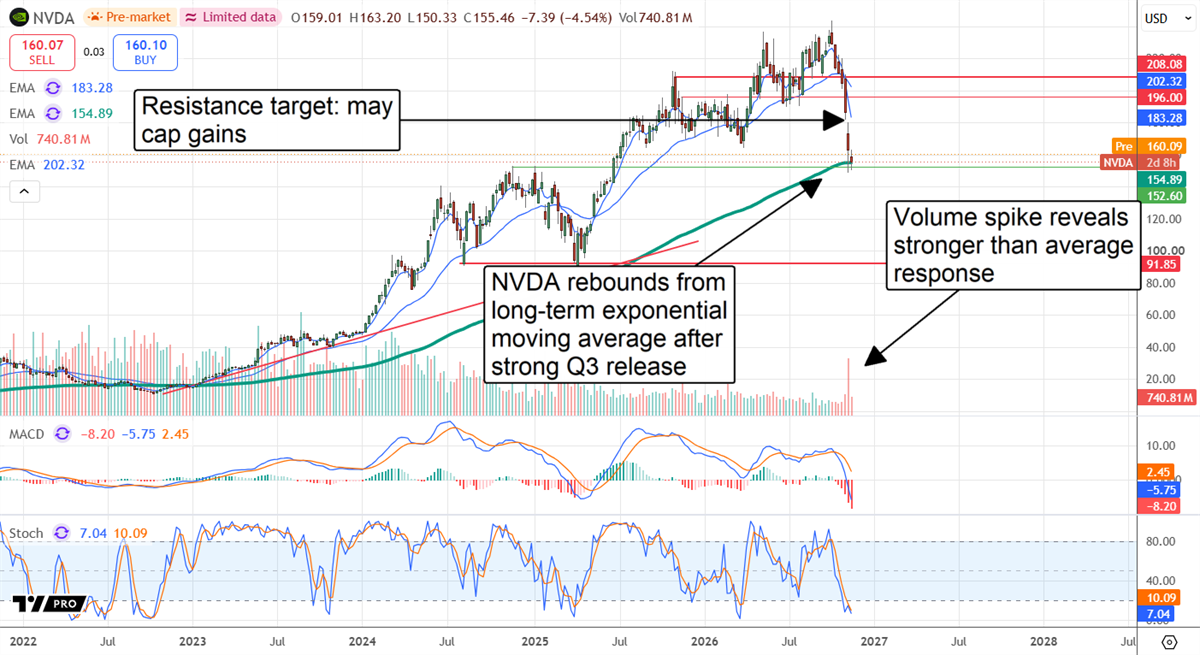
NVIDIA’s price action suggests a potential bottom: volume spiked as the stock hit closely watched technical levels, and shares subsequently rebounded. The post-release price action suggests the rebound may continue, but near-, mid- and long-term risks remain. The near-term risk is volatility; a rebound today could be followed by a sell-off tomorrow.
Investors who want to avoid this risk can wait for a follow-on signal, which is likely given the fundamentals and is consistent with generally accepted technical trading theory. That signal could come soon, but it may take time to develop. The mid-term risk is that more bad news could emerge and keep NVIDIA shares volatile for an extended period.
NVIDIA’s long-term risk lies in its executive transition. Although some investors are calling for Huang’s return, signals from the board suggest that won’t happen. The market needs to see a clear transition to a respected, capable CEO who can execute the roadmap Huang created.
The trading risk is that NVIDIA’s stock price could fall by more than 30%, creating a significant overhang that may cap future gains. However, valuation metrics suggest NVIDIA stock is deeply undervalued, pricing in deterioration and implosion rather than the acceleration indicated by Q3 results. Trading in the mid-teens relative to current-year forecasts, NVIDIA could rise by 50% in the near term and still trade at a discount to its historical premium. And trading in the low single digits relative to the 10-year outlook, the stock could rise by several hundred percentage points if the company successfully executes its plans.
. |


No comments:
Post a Comment