
A Message From Porter & Company
In December President Trump will take the stage and shock the world.
Standing before the leaders of the most powerful nations on earth, at his own resort in Miami, I believe he’s set to unveil something that will impact every dollar you have saved and invested.
The original agenda for the G20 Summit was development finance and climate change.
That’s been scrapped.
Instead, my research indicates Trump could unveil a radical monetary reset that no one has prepared you for.
I've been tracking this story for months.
And the deeper I investigate, the more convinced I become that what happens in that room could draw a brutal dividing line – between those who understand what's happening to their money, and those who do not.
Which means between now and December, there is a window. A chance to get ahead of what could be the most consequential change to our money in half a century.
It wasn't voted on. It wasn't debated in the Senate. And most Americans have no idea it's even taking place but…
President Trump is replacing the U.S. dollar.
Not with crypto. Not with a digital currency. Something far bigger than that – and it's already been signed and sealed in the back rooms of D.C., ready to be issued by the U.S. Treasury.
Bypassing every legal and political channel under the guise of "national security," Trump has enacted this total money reset using a landmark executive order (14241).
Whether you’re a Democrat or Republican, whether you support this new money or not, it doesn't matter.
Soon, every U.S. citizen will be forced to use Trump's New Dollar to fill their gas tank, buy groceries, and pay medical bills.
Which is why I've produced a critical new documentary laying out exactly what Trump's New Dollar means for your savings, your investments, and your family's financial future.
Detailing three important steps you can take today to prepare – including the name of a core band of assets connected to Trump’s initiative that could surge as a result.
As you’ll see in my briefing, the last time America reset its money like this – under Richard Nixon’s presidency in the 1970s – it created one of the greatest wealth divides in the history of our nation.
On one side, it minted an average of 1,300 new millionaires a day for over half a century. And on the other… the folks left behind, drowning in debt, with no idea how to use America’s new money to create wealth.
As Trump rolls out his new dollar, the question is:
Which side will you be on?

Good investing,
Porter Stansberry
PS. If you’re wondering what Trump’s new money will look like, when it will be issued, what it means for your investments and why it could be front-page news on December 14 – all of those questions are answered in my briefing.
Monday's Featured Content
Rocket Lab's Record Backlog Could Fuel a Rebound, But Neutron Raises the Stakes
Reported by Thomas Hughes. Date Posted: 11/10/2026.

Key Points
- Rocket Lab reported 73% year-over-year revenue growth and a record $3.6 billion backlog in the third quarter.
- Rocket Lab's technical indicators suggest a possible reversal, but its Neutron rocket is not expected to debut before 2027.
- Rocket Lab retains a Moderate Buy analyst consensus, although recent price-target cuts and continued losses present risks.
- Special Report: Today's stock pick is on me
Rocket Lab (NASDAQ: RKLB) shares fell more than 7% at one point in after-hours trading following an otherwise strong Q3 report. The move suggests the market failed to lift off, even as RKLB appeared poised to rebound ahead of the release. But investors shouldn’t read too much into the decline. Strong results were expected and delivered, setting up a potential sell-the-news and buy-the-dip scenario, with shares trading well below their recent highs.
Rocket Lab's Technical Indicators Point to a Potential Reversal
Technical indicators align with a potential rebound that could take the stock to all-time highs if the stars align. That alignment depends on strategic execution, which was evident in the release as backlogs swelled and visibility improved. Among the developing signals is a Strong Buy reading from the Stochastic Oscillator on two time frames, and potentially a third, assuming no major business hiccups, hurdles or setbacks arise.
The Stochastic Oscillator is interesting because it seeks to find order in chaos. It assumes that day-to-day price swings are random, but that prices will trend in one direction or another over time, depending on the fundamentals at play.
In this framework, a series of bullish crossovers near the bottom of the stochastic range—reflecting buying activity and firmer support as successive troughs move higher—distinguishes a Strong Buy signal from a Weak Buy signal. The first bullish crossover is a weak signal and far less reliable on its own. For the signal to be strong, it must repeat at least twice and be confirmed by other indicators, a condition the MACD Histogram currently supports on the daily chart. MACD, or Moving Average Convergence Divergence, measures market momentum, indicating whether bulls or bears are in control and whether they are gaining or losing strength.
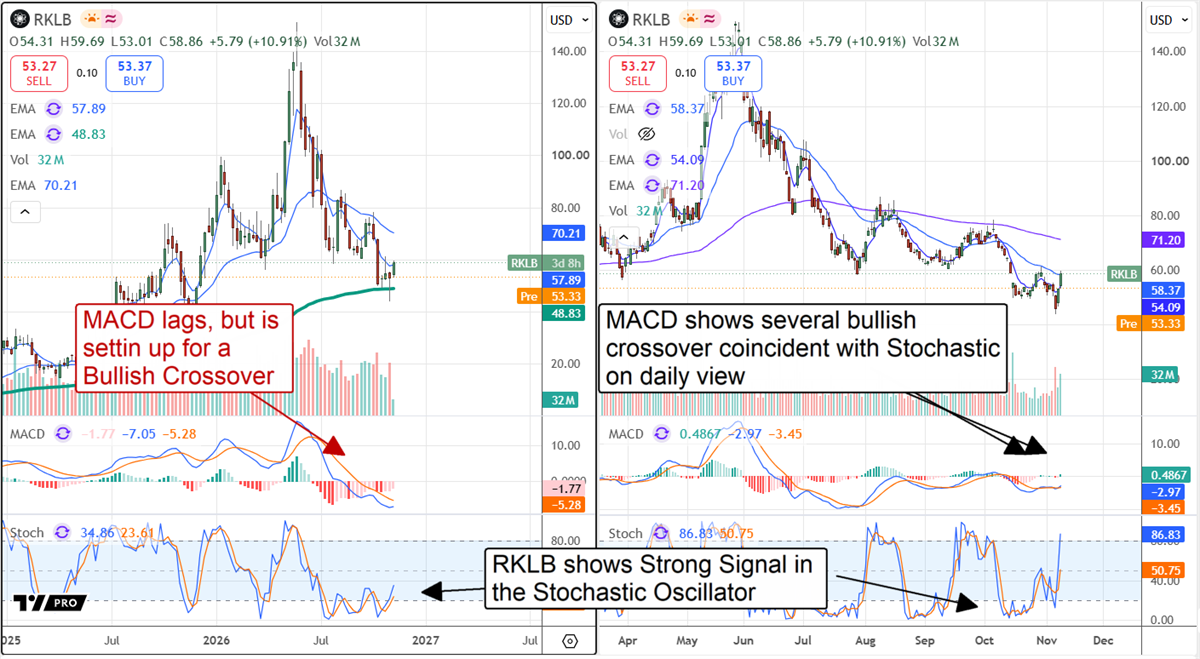
Bullish MACD crossovers on the daily chart echo the stochastic signals, potentially setting the market up for a bullish momentum swing on the weekly chart. The weekly chart is the linchpin: MACD has yet to show a bullish crossover, but it is moving in the right direction. If it turns positive, the signal would gain further confirmation for technical traders and investors and could trigger a larger, more sustained influx of capital.
Rocket Lab's Monthly Chart and Growing Backlog Support the Bullish Case
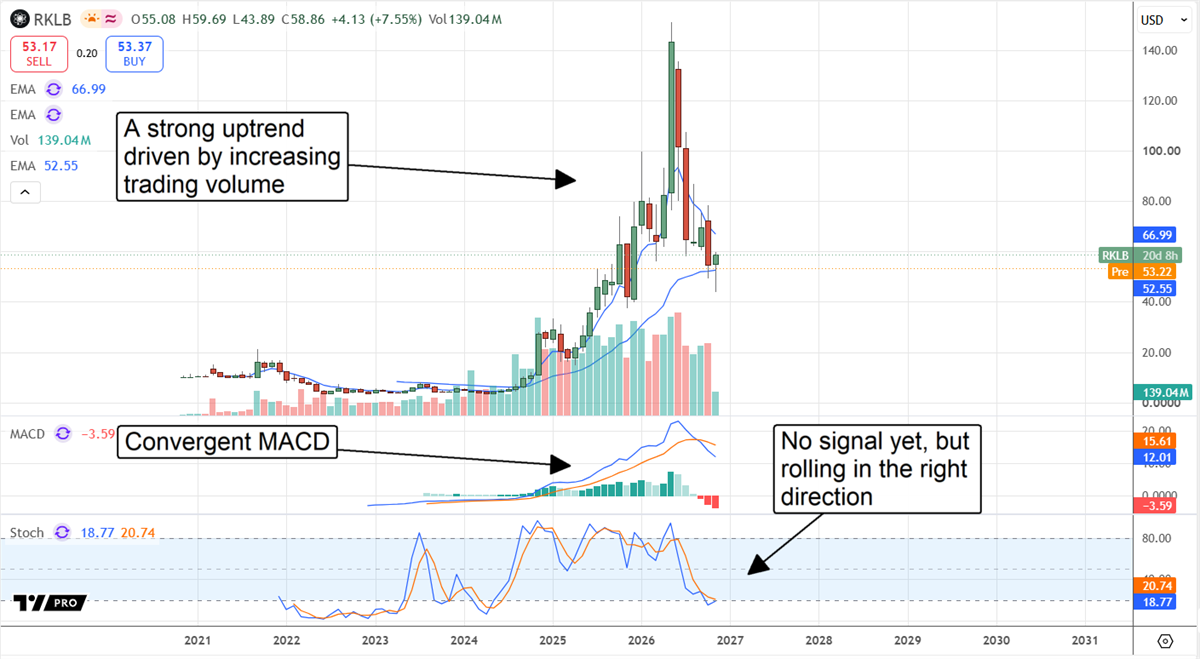
With signals developing on the daily and weekly charts, investors and traders could see a substantial move if and when the signal completes. The monthly chart provides the runway in this scenario, as it also reflects a deeply oversold market with the potential to bottom and reverse. Signs of strength on this time frame include rising market volume and MACD convergence in an uptrend, which could point to a retest of existing highs, if not the setting of new ones. Of course, this remains theoretical without a fundamental driver, which the company is providing.
Rocket Lab demonstrated the strength of its vertically integrated space business, reporting nearly 73% year-over-year revenue growth and exceeding the Q3 consensus by more than 4%. Launch and systems sales drove growth, while industrywide capacity constraints supported price realization. The only bad news was that losses were larger than expected, but strong execution helped offset that. The company is advancing across all business lines and actively pursuing its planned acquisition of Iridium Communications, which would add an operational, profitable low-Earth-orbit constellation to its portfolio if the transaction closes.
Backlog and guidance are key catalysts. Backlog swelled 52% sequentially, driven by nearly $1 billion in new launch contracts, bringing the total launch backlog to 117 launches, including several for the Neutron rocket. The first Neutron launch is targeted for no earlier than 2027, and future revenue growth and margin improvements depend on successful development and launches. Backlog stood at $3.6 billion at the end of Q3, equivalent to more than three years of revenue at the Q3 pace, although the timing of that revenue remains uncertain.
Price Targets Fall, But Analysts Remain Bullish on Rocket Lab
Analysts responded with mixed sentiment, weighing record Q3 revenue, backlog growth and guidance against wider losses. The positives kept sentiment firm at Moderate Buy, while the negatives prompted some price target reductions that dampened market appetite. Investors should consider the factors underpinning the bullish outlook, including coverage from 24 analysts, 18 of whom rate the stock Buy or Strong Buy. The consensus price target of about $100 also implies roughly 70% upside, with upcoming catalysts providing further support.
Rocket Lab’s catalysts center on backlog growth and contract conversion, which could reduce uncertainty in the outlook and drive robust revenue growth. Analysts forecast that growth could slow as early as next year, a potential headwind for the stock. However, this is partly due to the law of large numbers and the company’s rapid progress. Even so, revenue is forecast to grow about 40% in 2027. If the company sustains a compound annual growth rate of about 30% over the next decade, the business could grow by more than 1,000% and potentially reach adjusted profitability within the next year or two.
. |


No comments:
Post a Comment