
A Message From Weiss Ratings
Dear Reader,
I need to speak with you directly.
I want you to see the most important warning of my career …
And one of the most important warnings any American family will receive before the next great financial crisis hits this country.
I'm Dr. Martin D. Weiss. I'm a Wall Street Journal, BusinessWeek, and New York Times best-selling author.

And for 55 years I have run Weiss Ratings … the only 100% conflict-free, independent financial rating agency in America.
We are paid by no one we rate. We answer to no one but our subscribers.
And in the 55 years since I issued my first public warning before a financial crisis, I have publicly predicted six major American crashes, before they happened.
What I'm seeing now is a $3 trillion problem.
And the biggest danger right now is NOT just another stock market crash.
The biggest danger is NOT only a major bank failure.
Rather, it's a chain reaction of crashes and failures that could cause a global freeze in the financial markets. And it starts here:
Go here now to see the most important warning of my career
Good luck and God bless!
Sincerely,

Martin D. Weiss, PhD
Weiss Ratings Founder
Bonus News from MarketBeat.com
Dutch Bros Gave Wall Street What It Wanted, So Why Did the Stock Crater?
Authored by Jessica Mitacek. Publication Date: 11/7/2026.
Key Points
- Despite beating Q3 EPS and revenue estimates, Dutch Bros stock fell 21% as investors questioned the sustainability of its growth.
- Slowing customer traffic growth, rising costs, and a quarter-over-quarter decline in net income have raised doubts about profitability amid aggressive store expansion.
- Analysts remain largely optimistic, maintaining a Moderate Buy consensus rating even as insider selling and elevated short interest weigh on sentiment.
- Special Report: The biggest untaxed pile of money in America is yours
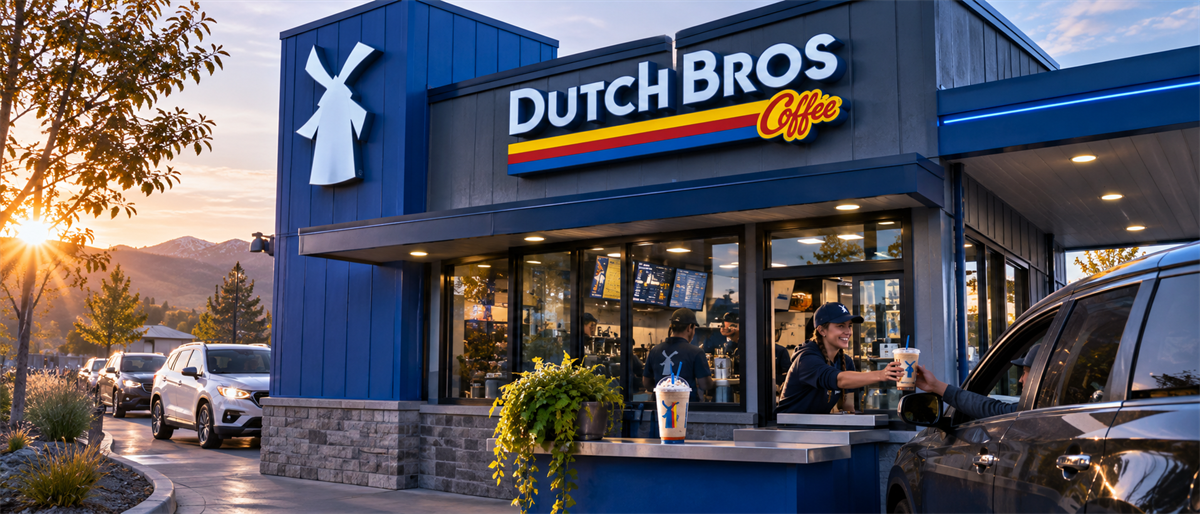
When specialty drink and coffee drive-thru operator Dutch Bros (NYSE: BROS) reported Q3 earnings after the market closed on Wednesday, Nov. 4, the company announced a double beat. Earnings per share (EPS) of 25 cents exceeded analysts’ forecasts of 24 cents, while revenue of $549.84 million beat the $548.27 million consensus.
But earnings are backward-looking, and shares plunged in after-hours trading, with the sell-off extending into Thursday. From the Nov. 4 close to the Nov. 5 close, BROS fell 21%.
The question isn’t whether Dutch Bros can continue to expand its footprint; management has already proven it can. The chain now has 1,328 locations, having opened 137 new shops through Q3. It needs to open another 48 in Q4 to meet its full-year target of at least 185 openings. The company is also targeting 250 new shops in 2027.
Instead, the company faces a higher bar to prove that its growth is sustainable.
The real question is whether existing locations can generate enough additional traffic to support the company’s ambitious expansion plans and justify its growth expectations.
The Good, the Bad, and the Ugly: Dutch Bros’ Earnings Beat Masks Slowing Customer Traffic
On paper, Dutch Bros’ Q3 report was impressive.
The company has beaten or met EPS expectations for 14 consecutive quarters, having last missed on earnings in Q1 2023. GAAP EPS grew approximately 43% year over year (YOY), following 40% growth in Q2.
Revenue growth came in at 29.81%, in line with the 30.64% average the company has posted over the past 11 quarters. Adjusted earnings before interest, taxes, depreciation, and amortization (EBITDA) increased 30% to $101 million.
Guidance was also strong. Dutch Bros raised its full-year outlook to at least $2.1 billion in revenue, at least 5% system same-shop sales growth, and approximately $380 million in adjusted EBITDA.
In her earnings call comments, CEO Christine Barone highlighted that the company opened 48 new locations in Q3. She added that systemwide same-shop sales increased 4.4%, while company-operated same-shop sales rose 5.4%.
However, systemwide customer visits increased just 0.4%, compared with 1.7% in Q2 and 5.1% in Q1. Average-ticket growth of 4% accounted for most of Q3’s same-shop sales increase.
While Dutch Bros doesn’t command the market share or market capitalization of Starbucks (NASDAQ: SBUX), some comparisons are useful, particularly for putting its growth metrics in context. In its Q4, Starbucks reported U.S. same-shop sales growth of 7.7%.
Barone also noted that Dutch Bros opened shops at the fastest 12-month pace in company history. Management now has “full visibility into the real estate pipeline to reach 2,029 shops in 2029.”
But that historic pace could be contributing to tempered profit expectations. While Dutch Bros’ attributable net income rose nearly 55% YOY to $27 million, it declined more than 27% quarter over quarter from $37 million in Q2.
The company cited consumer volatility concerns for Q4, driven by economic pressures such as gas and utility costs, as well as a smaller benefit from its food rollout. Cost pressures could also weigh on Q4 margins, with food and packaging costs expected to rise and Q3’s $4 million tariff-refund benefit not expected to recur. Elevated coffee, occupancy, utility, and freight costs could also persist, although management sees longer-term opportunities for operating leverage in those areas.
As the company accelerates its expansion, investors should monitor customer traffic and same-shop sales more closely than headline revenue. There is, however, an important bullish counterargument: Dutch Bros has posted 14 consecutive quarters of positive same-shop sales growth, and its existing locations are still attracting more customers YOY.
Concerns about sustainability aren’t stemming from a contraction in sales. They center on whether Dutch Bros can maintain profitability as its aggressive expansion continues, particularly as customer traffic growth slows and operating costs remain elevated.
Despite Sell-Off, Wall Street Still Sees Upside
Despite Dutch Bros’ continued top- and bottom-line strength, the stock has entered TradeSmith’s red zone for financial health following its Q3 earnings call and the subsequent sell-off.
But Wall Street remains bullish on BROS. Overall, it has a consensus Moderate Buy rating, along with an average 12-month price target implying more than 80% upside from the current share price. Of the 26 analysts currently covering the stock, 20 assign it a Buy rating and two assign it a Strong Buy.
The stock has a beta of 1.97, making it 97% more volatile than the broader market. Meanwhile, short interest remains elevated at 18.97% of the float, representing approximately 20.25 million shares sold short as of Oct. 15.
Institutional ownership remains healthy at 85.54%. But over the past year, MarketBeat reports $612.55 million in insider selling, compared with just $205,460 in purchases by one insider. Much of the selling involved founder and Executive Chairman Travis Boersma and was conducted under prearranged trading plans.
Shares are down more than 60% from their February 2025 all-time high and more than 50% from their year-to-date high.
. |


No comments:
Post a Comment