
A Message From Base Camp Trading
Hey Trader,
This certainly isn't going to win me any friends in the industry.
But I don't care.
For Black Friday, I'm practically giving away my proprietary "Snapback Indicator."
It's yours for just a single payment of $7. No strings attached.
When you see the Crash Alert, that's your cue to get out or go short.
When you see the Bull Run Alert, that's your cue to buy or go long.
Don't make another trade until you see this indicator in action. Best of all… I'm giving you LIFETIME access. Others paid $500 for this. But you're getting lifetime access to the Snapback Indicator for just $7.
Go here:
Black Friday Bombshell: "Snapback" Indicator For $7
In your corner,
Thomas Wood
Base Camp Trading
P.S. There's an unusual reason why I'm giving you such an outlandish discount on this incredible indicator. Full explanation here.
Featured Content from MarketBeat
ZIM Just Posted Huge Profits, But Its $35 Buyout Is Still in Limbo
By Chris Markoch. Article Posted: 11/21/2026.

Key Points
- ZIM's pending $35-per-share merger with Hapag-Lloyd, not its strong quarterly results, is now the main driver of investor sentiment and the stock's limited movement.
- The merger faces delays and uncertainty due to required Israeli regulatory approval, a shifted closing target to early 2027, and a Brazilian antitrust review.
- ZIM posted record third-quarter results, including 53% revenue growth and a 573% net income jump, and raised its 2026 adjusted EBITDA guidance for the second time.
- Special Report: Elon Musk’s One Stock Retirement Plan
ZIM Integrated Shipping Services (NYSE: ZIM) delivered a strong third-quarter earnings report on Nov. 18, but the stock has barely moved. The reason is that the company’s headline numbers bury the lead.
The key short-term driver for ZIM is the proposed merger with Hapag-Lloyd. The outlook for approval is best described as cautiously optimistic. Investors should understand that ZIM’s current share price reflects hopes for a positive outcome, but not full confidence in one.
That’s a headline risk, not a structural one. The company’s fundamentals continue to look strong.
A Record Quarter Driven by Freight Rates
By almost any measure, ZIM’s third quarter was exceptional. Revenue rose 53% year over year (YOY) to $2.71 billion. Net income jumped 573% to $830 million, or $6.88 per diluted share, compared with $1.02 per share a year earlier. Adjusted EBITDA more than doubled to $1.33 billion.
Higher freight rates did most of the work. ZIM’s average rate per 20-foot equivalent unit (TEU), the standard container measure, rose 55% to $2,480. Volumes grew more modestly: ZIM carried 962,000 TEUs, up from 926,000 a year earlier. The company also generated $1.22 billion in free cash flow.
Management raised full-year guidance for the second time. It now expects 2026 adjusted EBITDA (earnings before interest, taxes, depreciation, and amortization) of $3.3 billion to $3.5 billion, up from its previous range of $2.7 billion to $3.0 billion. The company also declared a dividend of $2.01 per share, payable Dec. 8, 2026.
Where the Hapag-Lloyd Deal Stands
On Feb. 16, 2026, ZIM Integrated Shipping Services announced a merger agreement with Hapag-Lloyd. Under the terms, Hapag-Lloyd would acquire ZIM for $35 per share in cash. ZIM’s board unanimously approved the deal, as did its shareholders at a special meeting on April 30, 2026.
But approval is still pending. Before the deal can be finalized, the two companies must clear several hurdles, including regulatory approvals. The most important of these is approval from the State of Israel under the requirements of the Special State Share (the "Golden Share").
In its earnings report, ZIM noted that its original application to the State of Israel had been terminated and that Hapag-Lloyd intended to submit a new application that would allow the merger to close in the first quarter of 2027.
That target has already slipped. ZIM initially aimed to close the deal by the end of 2026. Israel’s Finance Ministry and Prime Minister’s Office opposed the original structure, citing national security and independence concerns. Proposed revisions include a new route to Asia and a new fleet for the Israeli successor company. Brazil’s antitrust regulator has also opened a full review.
There is also a governance wrinkle: a shareholder group holding more than 10% of ZIM’s stock wants a new vote if the revised deal is materially different.
Why the Merger Matters to the Stock
When the merger was announced in February, ZIM shares jumped approximately 35%. Since then, the stock has traded in a defined range as investors have priced it based more on the merger terms than on the company’s fundamentals.
The chart shows that range clearly. Since September, ZIM has traded between roughly $27 and $31. On Nov. 19, the stock was near $29.60, just above its 50-day simple moving average (SMA). The moving average convergence divergence (MACD) indicator recently crossed above its signal line, a mildly bullish signal. However, the $35 deal price still caps the upside.
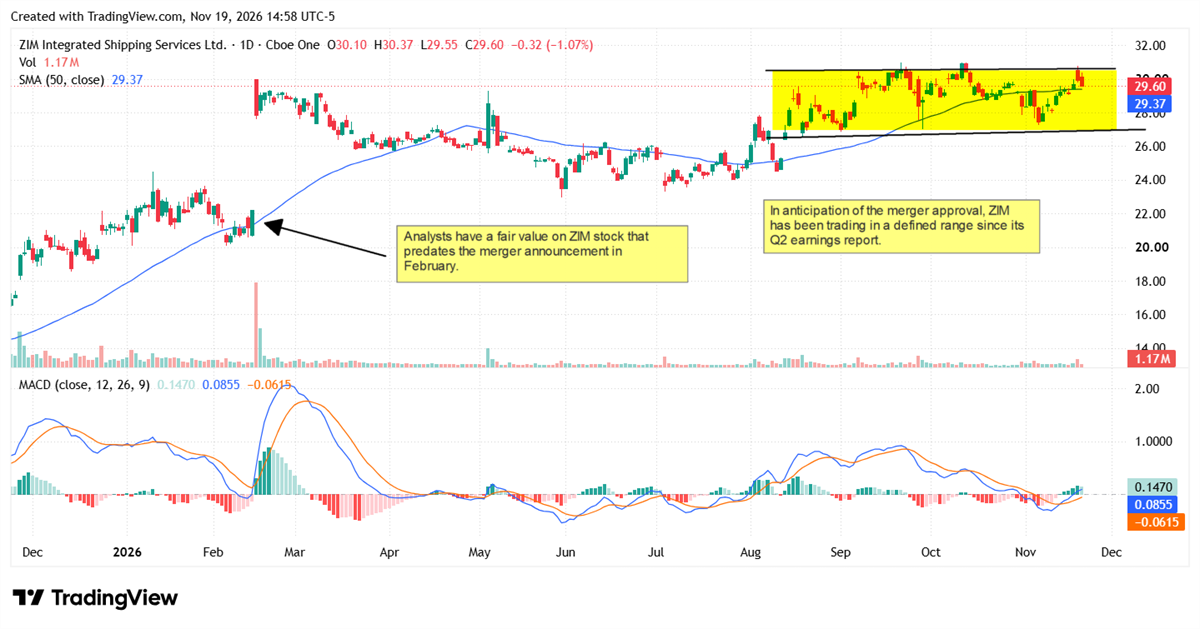
That’s the risk to shareholders. If the merger is not approved or faces further delays, ZIM could trade below its current price. That risk is reflected in the forecasts of the analysts tracked by MarketBeat. The consensus rating from eight analysts is Hold, with a $22.42 price target—more than 24% below ZIM’s price on the earnings date.
However, some of those targets predate ZIM’s two guidance increases. The stand-alone value of the business could be higher than the consensus suggests, which would soften the blow if the deal falls apart.
The Math Favors Patience, With Caveats
For investors willing to accept the risk, the math is simple. At about $29.60, the $35 deal price offers roughly 18% upside. The $2.01 dividend represents nearly 7% of the share price for eligible shareholders, although the stock typically adjusts downward when it goes ex-dividend.
If the deal closes on schedule, merger proceeds would arrive early next year.
The downside is just as clear. A failed deal could push ZIM toward the analysts’ consensus price target. Freight rates are also volatile. Management flagged recent softening, though it expects a pickup in January ahead of Chinese New Year.
ZIM is no longer a pure shipping stock; it’s a bet on an Israeli regulatory decision. Strong fundamentals offer a cushion if the deal fails, but investors should size their positions with that outcome in mind.
. |


No comments:
Post a Comment