
A Message From Behind the Markets
Fellow Investor,
The biggest energy deadline in American history...
Just aimed its full firepower at ONE company.
See, on July 4th, the One Big Beautiful Bill Act killed the federal tax credits that powered alternative energy for years.
But here's what almost nobody knows:
When the White House killed credits for solar, wind, EVs, and every other renewable energy source in America…
They left one untouched.
Not only that - they reclassified it alongside oil and nuclear...
And gave it eight years of credits.
Because in June 2025, a drilling crew working near the Grand Canyon...
Unearthed a well of clean energy producing almost 8 times the output of the largest oil well in Saudi Arabia...
Capable of powering civilization for two million years.
Right here on American soil.
Everything changed that day.
Google signed a 15-year contract...
Bill Gates wrote a $100 million check.
And on July 4th, the government handed this energy source its biggest advantage ever.
One company owns the entire chain.
Time is running out to be an "early investor."
I recommend placing your trade at tomorrow's market open.
Go here now for the Grand Canyon breakthrough ticker >>
"The Buck Stops Here,"
Dylan Jovine, CEO and Founder
Behind the Markets
Further Reading from MarketBeat
Marriott's Earnings Beat Shows Why It's More Than a Bet on Travel Demand
Authored by Chris Markoch. Published: 11/3/2026.
Key Points
- Marriott beat third-quarter earnings expectations and raised its full-year 2026 outlook.
- Hotel conversions and growing franchise and credit card fees are helping Marriott expand without the cost of building every new property.
- Marriott's valuation remains a concern despite strong earnings growth and an improving outlook.
- Special Report: Elon Musk… A Total Fraud?
Marriott International Inc. (NASDAQ: MAR) reported third-quarter 2026 results that topped expectations across the board. The hotel giant reported adjusted earnings per share (EPS) of $3.02, up 22% from $2.47 a year ago and above the consensus estimate of $2.84. Revenue rose 8% to $7.01 billion.
Worldwide revenue per available room (RevPAR) grew 6.5%. The U.S. & Canada led with 7.4% growth, while international markets rose 4.4%. The Luxury category stood out: Systemwide luxury RevPAR in the U.S. & Canada jumped 11.9%, and The Ritz-Carlton posted a 14.6% gain.
Not every region contributed to growth. Middle East & Africa RevPAR fell 5.3% amid the ongoing conflict, while Greater China was roughly flat. Still, management said Middle East trends improved meaningfully from the second quarter. The company also credited the World Cup with boosting results in June and July.
Despite those regional headwinds, management raised its full-year outlook. Marriott now expects 2026 RevPAR growth of 4.5% to 5%. Adjusted EPS guidance increased to $12.07–$12.14, up from $11.64–$11.81. But the headline numbers don't tell the whole story. Investors often view Marriott as a bet on travel demand, yet the third quarter showed that the company's fee revenue is growing faster than RevPAR.
How Hotel Conversions Are Fueling Marriott's Growth
Capital expenditures are a major consideration for companies investing heavily in infrastructure. Those costs can reduce free cash flow or require additional financing, particularly when interest rates are high.
That's one reason Marriott's business model warrants a closer look. Hotel owners generally cover construction costs, allowing Marriott to expand without making those investments itself. Marriott's third-quarter report highlighted another advantage: converting existing properties to its brands helps the company expand more quickly, without waiting for new hotels to be built.
Marriott brought many existing independent properties into its system. These conversions can add rooms and begin generating fees sooner than newly constructed hotels.
Conversions accounted for more than a third of signings and more than 40% of openings in the first nine months of 2026. Marriott also reported record year-to-date global organic signings. Net rooms grew 4.6% year over year to nearly 1.834 million, and the development pipeline reached a record of more than 634,000 rooms.
That doesn't mean growth is free. Marriott still expects $1.25 billion to $1.35 billion in investment spending this year, including contract acquisition costs paid to win new deals. Those expenses still affect Marriott's cash flow, even though hotel owners generally cover construction costs.
Marriott's Fee Revenue Is Growing Faster Than RevPAR
The capital-light model is reflected in the fees Marriott collected.
-
Gross fee revenues rose 14% to $1.52 billion, more than double the pace of RevPAR growth.
-
Franchise fees climbed 15% to just over $1 billion.
-
Incentive management fees jumped 22% to $181 million, with every region posting gains.
A major driver was co-branded credit card fees. These fees aren't directly tied to hotel occupancy; they also depend on how many people carry a Marriott card and how much they spend. Marriott Bonvoy reached about 309 million members, an audience that helps make Marriott's co-branded cards attractive to issuers.
That fee growth also supported earnings. Adjusted EBITDA rose 12% to $1.51 billion. Marriott repurchased 3.5 million shares for $1.3 billion in the quarter, and its diluted share count fell about 4% year over year. The company expects to return at least $4.8 billion to shareholders in 2026. One caveat: debt rose to $16.8 billion from $16.2 billion at year-end, and net interest expense climbed 13%.
Marriott's Valuation Remains a Concern for Investors
The biggest concern for Marriott shareholders after the earnings report is valuation. MAR is now trading about 3.5% below its 52-week high, with a price-to-earnings ratio of around 43.
Since the report, several analysts have raised their price targets for Marriott, although their outlooks on the stock remain mixed.
That mixed outlook highlights a broader question about how investors should value Marriott. If investors view the company as a capital-light licensing and loyalty business, its valuation may make sense.
As a cyclical hotel stock, however, it may be priced for perfection. Travel demand has held up in 2026, supporting Marriott's growth outlook even as its valuation remains a concern.
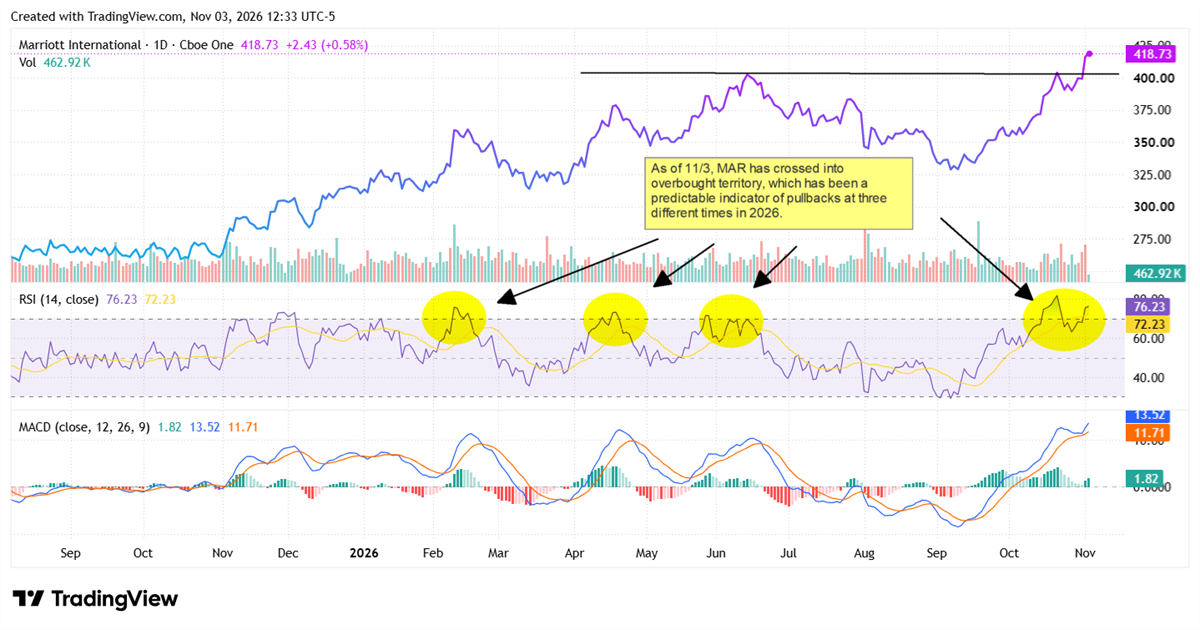
The MAR chart shows momentum is on the side of the bulls. The moving average convergence divergence remains above its signal line, suggesting momentum hasn't rolled over yet.
However, the relative strength index (RSI) sits near 76, firmly in overbought territory. The last three times RSI moved above 70—in February, April and June—shares pulled back.
That means another pullback wouldn't be surprising. If one occurs, the $400 level that capped the stock in June could act as support.
. |


No comments:
Post a Comment