
A Message From Weiss Ratings
Dear Reader,
I need to speak with you directly.
I want you to see the most important warning of my career …
And one of the most important warnings any American family will receive before the next great financial crisis hits this country.
I'm Dr. Martin D. Weiss. I'm a Wall Street Journal, BusinessWeek, and New York Times best-selling author.
And for 55 years I have run Weiss Ratings … the only 100% conflict-free, independent financial rating agency in America.
We are paid by no one we rate. We answer to no one but our subscribers.
And in the 55 years since I issued my first public warning before a financial crisis, I have publicly predicted six major American crashes, before they happened.
What I'm seeing now is a $3 trillion problem.
And the biggest danger right now is NOT just another stock market crash.
The biggest danger is NOT only a major bank failure.
Rather, it's a chain reaction of crashes and failures that could cause a global freeze in the financial markets. And it starts here:
Go here now to see the most important warning of my career
Good luck and God bless!
Sincerely,

Martin D. Weiss, PhD
Weiss Ratings Founder
Special Report
2 Utility Stocks May Offer Relief From AI Volatility, But Rates Are the Real Story
Written by Dan Schmidt. Date Posted: 11/20/2026.
Key Points
- Utility stocks can offer investors dividend income and potentially lower volatility as technology stocks struggle.
- UGI's Pennsylvania rate settlement provides phased revenue increases, while its newly announced business separation could reshape its investment profile.
- Southwest Gas has a pending Arizona rate case and proposed formula-rate mechanism that could support future earnings growth.
- Special Report: When everyone panics, look at one color
The AI trade took another leg down this week despite strong earnings from NVIDIA Corp. (NASDAQ: NVDA). While dogs and cats aren’t living together yet, a mild hysteria has taken hold in the tech sector. The Nasdaq-100 is already down about 4.5% this month, and a rotation into safer sectors appears well underway. Investors are questioning whether hyperscaler spending can continue growing at an exponential pace and looking for protection from AI-driven volatility. Utilities are a popular choice in volatile markets because their rates are heavily regulated and they frequently pay healthy dividends. Two utilities offer steady dividend income and potential rate-case catalysts that could boost earnings.
Why Utilities Perform Well in Market Downturns
Burdensome regulation is typically a reason investors avoid a company or industry. But in the utility sector, regulation is necessary because these companies have a natural monopoly in their territories. Once critical infrastructure like pipes and wiring networks is in place, it makes little economic sense for a competitor to build a duplicate network and compete for customers. Because each utility operates as a monopoly in an exclusive territory, a state regulatory commission sets prices. The company must also serve all its customers reliably if it wants to make the case for higher rates.
When utility companies file for higher rates, it’s called a rate case. They must argue that increases are needed to recoup costs and capital investments. State public utility commissions (PUCs) give these companies an opportunity to earn a reasonable return on their investments. Still, consumers and other advocates often push back during rate cases, and utilities typically settle for less than they initially request. Rate base growth is the utility sector’s earnings engine: Utilities can earn an approved return on capital expenditures (CapEx) included in their rate base, subject to the return on equity (ROE) authorized by regulators. Approved investments can support earnings growth, while timely rate adjustments help reduce the lag between spending capital and recovering it.
2 Utilities With Healthy Dividends and Upside Catalysts
Beyond a bullish rate-case catalyst, both of these companies return ample cash to shareholders through dividends. Each dividend currently yields at least 2.5%, with a payout ratio below 70%. A payout ratio below 70% can leave room for dividend growth while helping balance utilities’ substantial capital spending needs.
UGI Corp: Base Rate Settlement Offers 2 Years of Visible Revenue Growth
UGI Corp. (NYSE: UGI) hasn’t raised its dividend payout since 2023, and that won’t change this quarter after management declared another 37.5-cent-per-share payout on Nov. 18.
UGI also announced plans on Nov. 18 to spin off its global liquefied petroleum gas business in 2027, although dividend policies for the resulting companies have not yet been finalized. The company trades at 11.95 times forward earnings, and the Pennsylvania PUC resolved its base rate case on Oct. 1.
The state approved rate increases 35% below UGI’s request, with the increases phased in over two years. The agreement will provide a $65 million two-step increase in annual operating revenue: UGI will receive an additional $40 million in October 2026 and another $25 million in October 2027. While the company cannot file a new base rate request until 2029, the settlement provides a more predictable path to revenue growth over the next two years.
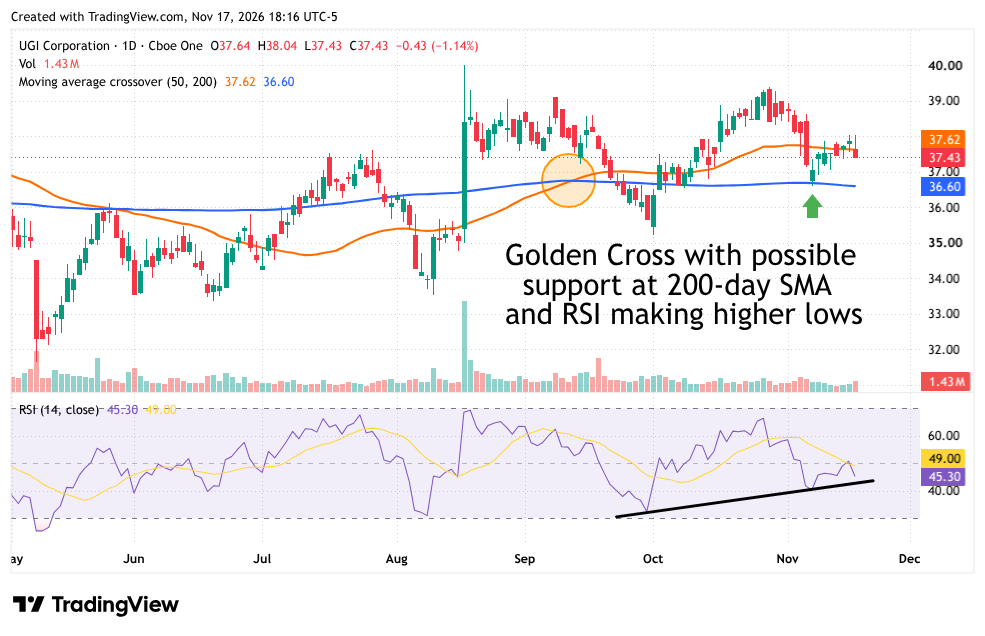
UGI shares have gone nowhere so far in 2026, gaining just over 1% year to date. But with the rate case in the rearview mirror, technical signals are starting to show bullish potential. A golden cross in September helped push the share price above the 50-day and 200-day moving averages, and the 200-day average could now serve as support to keep the stock elevated.
The relative strength index (RSI) has also bounced off the October oversold signal, making higher lows as it approaches the bullish-bearish dividing line of 50. An RSI above 50, combined with support at the 50-day moving average, would be a strong sign that a new uptrend has begun, so investors should monitor these levels closely over the next few weeks.
Southwest Gas Holdings: Pure-Play Utility With Potentially Lucrative Rate Case Looming
Last year, Southwest Gas Holdings Inc. (NYSE: SWX) exited its position in infrastructure firm Centuri Holdings Inc. (NYSE: CTRI), leaving it as a pure-play gas utility serving growing Western markets. Operating in parts of California, Arizona and Nevada, Southwest Gas has a growing rate base and expects adjusted earnings per share (EPS) to compound at an annual rate of 12% to 14% through 2030.
The company also has a rate-case catalyst in Arizona. It is the first rate case since the Arizona Corporation Commission (ACC) approved a controversial measure called formula rates, which could allow annual rate adjustments under an approved formula rather than requiring a traditional rate case each year.
Southwest Gas initially requested a $101 million rate increase for its Arizona territory, later reducing the request to $91.3 million. In October, commission staff recommended a $58.2 million increase. A hearing is scheduled to begin Dec. 7, and the new rates are expected to take effect in April 2027, subject to regulatory approval.
Although the gap between the request and recommendation is large, the bigger story is the potential transition to formula rates. If approved, the proposed structure would allow annual cost-of-service adjustments between full rate cases, reducing the lag between capital investment and returns.
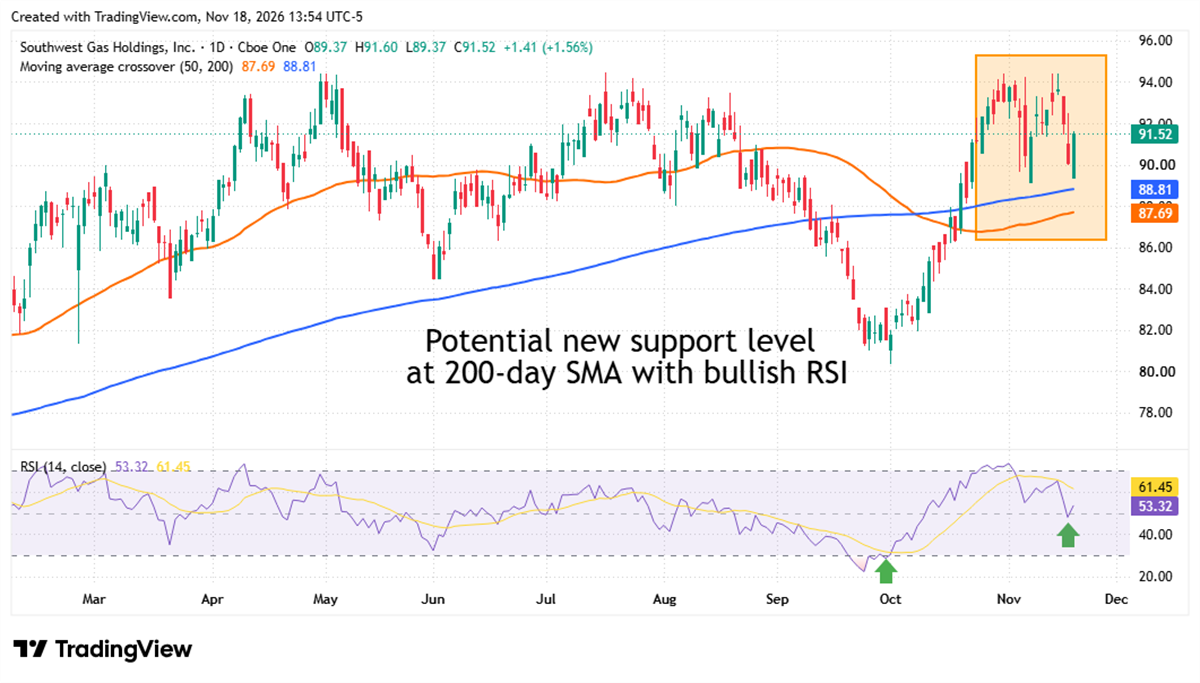
SWX shares are up approximately 13% year to date, but the path has been anything but linear. The stock found support at the 50-day moving average for most of the year before a September drawdown pushed the price below both the 50-day and 200-day moving averages.
Like UGI, the stock bounced off an RSI oversold signal in October and has been trending higher since, finding new support along the 200-day moving average. The September decline, accompanied by a death cross, could prove to be a bear trap. Management also reaffirmed its full-year 2026 adjusted earnings guidance in the Q3 report on Nov. 4.
. |


No comments:
Post a Comment