
A Message From Weiss Ratings
Dear Reader,
According to Wall Street legend Dr. Martin D. Weiss, there's a $3 trillion disaster in the making in the markets, and it could have a sizable impact on your wealth.
"The crisis that's emerging now is just the tip of the iceberg," says Dr. Weiss, who has made shocking and accurate predictions for 55 years, including predicting the Dot-Com collapse and the implosion of Fannie Mae, Bear Stearns and Lehman Brothers in the 2000s.
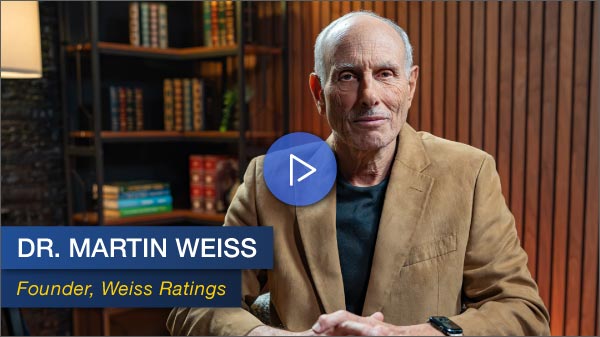
The New York Times has credited Weiss as being "the first to see the dangers." Forbes called him "Mr. Independence." His contributions have been recognized by the U.S. Government Accountability Office.
"The biggest danger is not just another stock market crash," he continues. "The biggest danger is not only a major bank failure. Rather, it's a chain reaction of crashes and failures that could cause a global freeze in the financial markets," adds Weiss.
The tip of this iceberg? It's already emerging and impacting perhaps thousands of investment accounts across America.
Weiss, who has testified in front of Congress, says there are five specific steps every American must consider making with their money, before it's too late.
"When the system freezes, nothing works. Virtually everything shuts down. Companies cannot make payroll. Banks cannot meet their daily obligations. Even the Federal Reserve cannot fix it without massive, Herculean efforts."
Weiss is doing everything he can to warn the public while there's still time to prepare, including issuing press releases and reaching out to media outlets.
In fact, Dr. Weiss has urged us to post a brand-new, urgent warning on our public website …
You can access his video message — free of charge — when you click here.
Sincerely,
Eliza Lasky
Weiss Advocate
Further Reading from MarketBeat
5 Beaten-Down Growth Stocks Trading Like Value Plays as Cash Chases Mega-Caps
Authored by Bridget Bennett. Article Posted: 10/26/2026.
Key Points
- Teradyne pairs a fast-growing semiconductor testing business with a smaller robotics unit that is growing even faster.
- Grail's Galleri multi-cancer blood test faces a possible FDA decision in early 2027, with Medicare coverage seen as the bigger catalyst.
- FormFactor, Kratos Defense and Fabrinet have pulled back sharply despite growth stories in quantum computing, drones and AI infrastructure.
- Special Report: Elon Musk… A Total Fraud?
The S&P 500 recently sat just 2.5% below its all-time high. Look beyond the index, though, and the picture gets uglier. Roughly 40% of its members were trading below their 50-day moving averages, and about 1 in 3 had already slipped into a bear market.
That split helps explain why so many portfolios are lagging in what looks like a strong market. Gains have pooled in a handful of mega-caps, such as NVIDIA (NASDAQ: NVDA) and Amazon.com (NASDAQ: AMZN). Many of the high-growth names investors loved a year ago are 20% to 30% below their highs, or worse.
By one growth strategist's count, some of those laggards now trade at price-to-earnings (P/E) ratios below 20 while growing revenue 30% to 40% a year. When growth gets priced like value, the real question isn't whether the businesses work. It's whether the market has simply stopped paying attention.
Beaten-Down Growth Stocks Turn Into Value Plays as Money Crowds Into Mega-Caps
Matt McCall, head innovations strategist at Monument Traders Alliance, frames the disconnect as a money-flow problem, not a fundamentals problem. Investable capital is limited, and lately it has crowded into companies the market views as pure AI plays.
Biotech illustrates the pattern. Breakthroughs have accelerated for years while stocks have lagged because money has flowed to AI. In McCall's view, the next leg could see capital rotate from mega-caps toward the mid- and small-cap companies driving AI's next phase.
His track record gives that patience some weight. Over roughly 20 years, more than 60 of his picks have gained at least 10-fold, by his count. At the March 2009 market bottom, his eight-stock "Andrew Jackson portfolio" included two future bankruptcies, General Motors (NYSE: GM) and Eastman Kodak (NYSE: KODK), alongside Advanced Micro Devices (NASDAQ: AMD), then trading at about $2. None of his big winners went straight up. Each endured steep pullbacks along the way.
Semiconductor Testing Offers a Low-Cost Path to Robotics and Quantum Computing
Two of the five picks share a playbook: buy a profitable chip-testing business and get exposure to an emerging megatrend almost for free.
Teradyne (NASDAQ: TER), the largest of the group at roughly $50 billion, is known for its semiconductor test equipment. It also runs two robotics divisions, including one focused on collaborative robots, or cobots, like the automated arms used on factory floors. McCall considers it his blue-chip robotics holding.
The growth is hard to ignore. According to McCall, estimates call for about 130% earnings growth this year and roughly 30% annually after that, with revenue up 61%. Robotics is growing quickly from a small base. The stock has climbed over 100% in the last 12 months but has pulled back, partly because big beats are already expected.
Watch to see whether robotics grows large enough for the market to value it on its own.
FormFactor (NASDAQ: FORM), at about $8 billion, applies the same logic to quantum computing. It tests chips at cryogenic temperatures, and two of the three main quantum approaches require extreme cold to work. Whether IonQ (NYSE: IONQ), Rigetti Computing (NASDAQ: RGTI), D-Wave Quantum (NASDAQ: QBTS) or an unknown private player wins, the testing still has to happen.
Breakthrough claims from Quantinuum (NASDAQ: QNT) and Google parent Alphabet (NASDAQ: GOOGL) keep the theme alive, though real-world use cases may not arrive until around 2030, according to McCall's timeline. Meanwhile, quantum computing still accounts for a small slice of revenue, so FormFactor's stock hasn't moved in lockstep with the rest of the industry.
Cancer Screening and Drone Warfare Offer High-Risk, High-Reward Catalysts
Grail (NASDAQ: GRAL) is the binary bet.
Its Galleri blood test screens for more than 50 cancers, potentially as early as stage zero, and an FDA advisory committee recommended it in September. In McCall's view, approval looks likely in early 2027, with Medicare coverage the bigger prize, since the test targets people over 50.
The stock more than doubled in a couple of months on that hope, after losing nearly half its value in a single week within the past year. At roughly $5 billion in market value, a move to $20 billion would represent a fourfold increase. A buyout by a giant like Johnson & Johnson (NYSE: JNJ) is plausible, according to McCall. A regulatory stumble is the obvious risk.
Kratos Defense & Security Solutions (NASDAQ: KTOS) sits at the opposite end of the sentiment cycle, about 70% below its peak, by McCall's estimate. The $7.5 billion company builds unmanned aircraft that fall between small drones and fighter jets, competing with Lockheed Martin (NYSE: LMT) and RTX (NYSE: RTX).
Drone stocks like Red Cat Holdings (NASDAQ: RCAT) and Ondas Holdings (NASDAQ: ONDS) surged and slumped together, while four drone ETFs launching at once looked like a classic short-term top. With proposals to lift U.S. defense spending from about $1 trillion to $1.5 trillion and Kratos already holding government contracts, a return to fair value alone could mean a double, in McCall's view.
He prefers spreading drone exposure across three or four stocks rather than buying an ETF.
AI Infrastructure Spending Looks More Like 1995 Than 1999
Fabrinet (NYSE: FN), a roughly $11 billion company, supplies the photonics and optics that move data faster inside data centers. It's down about 25% over the past year as investors debate whether AI is in a bubble and question the circular financing behind the buildout.
The parallel McCall draws is 1995, not 1999. Skeptics thought the internet had peaked, yet the S&P 500 roughly tripled through 1999, even after Alan Greenspan's 1996 "irrational exuberance" warning. Cisco Systems (NASDAQ: CSCO) built the networks and became one of the era's biggest winners.
Fabrinet plays a similar picks-and-shovels role today, and without that infrastructure, AI would stall.
Discounted Prices on Intact Growth Stories Reward Patience Over Timing
Teradyne, FormFactor, Grail, Kratos and Fabrinet each ride a long-running shift, from robotics and quantum computing to early cancer detection, autonomous defense and data center buildouts. Each has been marked down while its underlying story has held. The stories haven't broken; the prices have fallen.
None of this depends on calling a bottom, which McCall freely admits nobody can do. It does depend on execution: Teradyne sustaining its earnings pace, Grail clearing regulators, Kratos winning drone dollars, FormFactor scaling its quantum work and AI spending holding up for Fabrinet.
The risk is that a regulatory miss, a data center slowdown or a deeper risk-off move keeps these names under pressure for longer. The upside is that money rotating out of crowded mega-caps could quickly find smaller, cheaper growth stories.
Expect volatility either way. Stay focused on earnings delivery and catalyst milestones, because that's what moves high-growth stocks out of the bargain bin.
For the AI names McCall's team says to avoid, plus the growth stocks positioned for the next wave, get Matt McCall's McCall Innovation Report and its Great AI Shock research.
. |


No comments:
Post a Comment