
A Message From Banyan Hill Publishing
Dear Reader,
Three days into his second term, President Trump signed Executive Order 14178.
The press barely noticed.
But buried inside was the legal green light for the boldest change to American money in over 100 years. And it’s finally about to take effect.
I’ve spent months digging into what this order actually means.
What I found could send shockwaves through the financial system:
Musk — with the quiet cooperation of the U.S. Treasury — is now positioned to “reboot” the dollar itself.
Not someday. Potentially as soon as January 18. And it could all come down to one vote — led by Trump’s own Treasury Secretary.
When it happens, life as we know it could change… and investors who saw it coming could make a fortune.
Go here for the full story.
Regards,
Ian King
Chief Strategist, Strategic Fortunes
This ad is sent on behalf of Banyan Hill Publishing.
Additional Reading from MarketBeat
Tower Semiconductor's Earnings Are Soaring—So Why Is Its Stock Down More Than 50%?
Authored by Thomas Hughes. Published: 11/4/2026.
Key Points
- Tower Semiconductor reported record Q3 revenue of $526 million, up 33% year over year, alongside triple-digit earnings growth and strong Q4 guidance.
- Despite record earnings and expanding silicon photonics contracts, Tower's stock has fallen more than 50% from its 2026 peak amid valuation concerns.
- Institutional investors, who own more than 70% of shares, have resumed buying in early Q4, suggesting the stock's pullback may be bottoming.
- Special Report: Elon Musk: America Is "1,000% Going To Go Bankrupt"
AI markets have firmly shifted from speculation to execution, and Tower Semiconductor (NASDAQ: TSEM) is centrally positioned to benefit. As demand for AI infrastructure accelerates, the company is delivering record earnings, yet its stock has fallen more than 50% from its 2026 peak.
Tower is a leading specialty foundry for silicon photonics (SiPho) and silicon-germanium (SiGe) technologies, both of which help overcome power and data-transmission bottlenecks in AI data centers.
Simply put, Tower sticks little lasers onto the chips, enabling faster, more energy-efficient data transmission that helps AI data centers handle growing computing demands.
Despite the steep stock-price pullback, Tower has several catalysts working in its favor: leadership in a rapidly growing industry, substantial customer commitments that provide revenue visibility, government-backed expansion, and strategic partnerships that could fuel further growth.
Tower Semiconductor Forecasts Its Strongest Growth Period Ahead
Tower Semiconductor posted robust Q3 earnings, reporting record revenue and profits while issuing strong Q4 guidance.
Strong demand for high-speed connectivity drove revenue growth of 33% to $526 million, beating the analyst consensus estimate of $521.83 million by approximately $4.33 million. The RF Infrastructure segment expanded significantly, with revenue nearly tripling year over year (YOY) and accounting for 56% of total sales, up from 27% a year earlier.
Even more impressive than Tower's revenue growth was its margin expansion, which helped drive triple-digit earnings growth. Gross profit grew by 92%, driven by scale leverage and supported by operational quality. Operating profit grew 2.5 times, and net profit increased 2.2 times, driving GAAP earnings of $1.05 per share—up more than 100% YOY. Cash from operations increased approximately 33% year over year to $185 million.
Looking ahead, investors can expect this strength to continue. The company issued strong guidance, projecting approximately $600 million in revenue versus the analyst consensus of $578 million, representing 36% year-over-year growth.
With capacity expansions progressing faster than anticipated and customer contracts supporting demand, Tower could exceed its revenue forecasts and deliver further earnings growth. In May, the company announced $1.3 billion in silicon photonics contracts tied to 2027 revenue, along with $290 million in customer prepayments for capacity reservations.
Other factors pointing to potential outperformance include management's forecast that demand will help the company avoid its typical Q1 seasonal slowdown, AI-related optical tailwinds, and structural margin expansion tied to capacity utilization and product-mix shifts.
Valuation Remains a Headwind, But Tower's Growth Outlook Offers Hope
Tower's elevated valuation, at approximately 52 times trailing earnings, continues to weigh on its stock price despite the company's strong growth outlook.
Analyst responses to the Q3 results highlight this headwind, with several price target reductions emerging.
However, those reductions don't necessarily undermine the company's long-term growth prospects.
Tower's projected earnings growth could make its current valuation considerably more attractive over time.
Management's financial model targets $3.6 billion in annual revenue and $1.2 billion in net profit by 2028, supported by expanding silicon photonics demand and manufacturing capacity. If Tower achieves those targets and sustains its growth trajectory through 2030, its earnings-based valuation could improve substantially, potentially supporting significant stock-price appreciation.
In this environment, analyst price-target reductions could also set the stage for a stock-price advance, as strong future results may lead analysts to adopt a more bullish posture.
Until then, MarketBeat data shows a Moderate Buy consensus rating, rising coverage, firming sentiment, and an average price target implying more than 80% upside.
Institutional Activity Could Signal a Bottom for TSEM
Institutional activity suggests that TSEM’s H2 price pullback may be nearing a bottom or may have already bottomed. Institutions own more than 70% of the shares, providing a solid support base. After selling in Q2 and Q3, which reduced overall activity to multi-year lows, they returned to buying in early Q4 as the share price declined.
They may continue buying at these levels, underpinning support and providing a launchpad for prices when the market reconnects with reality.
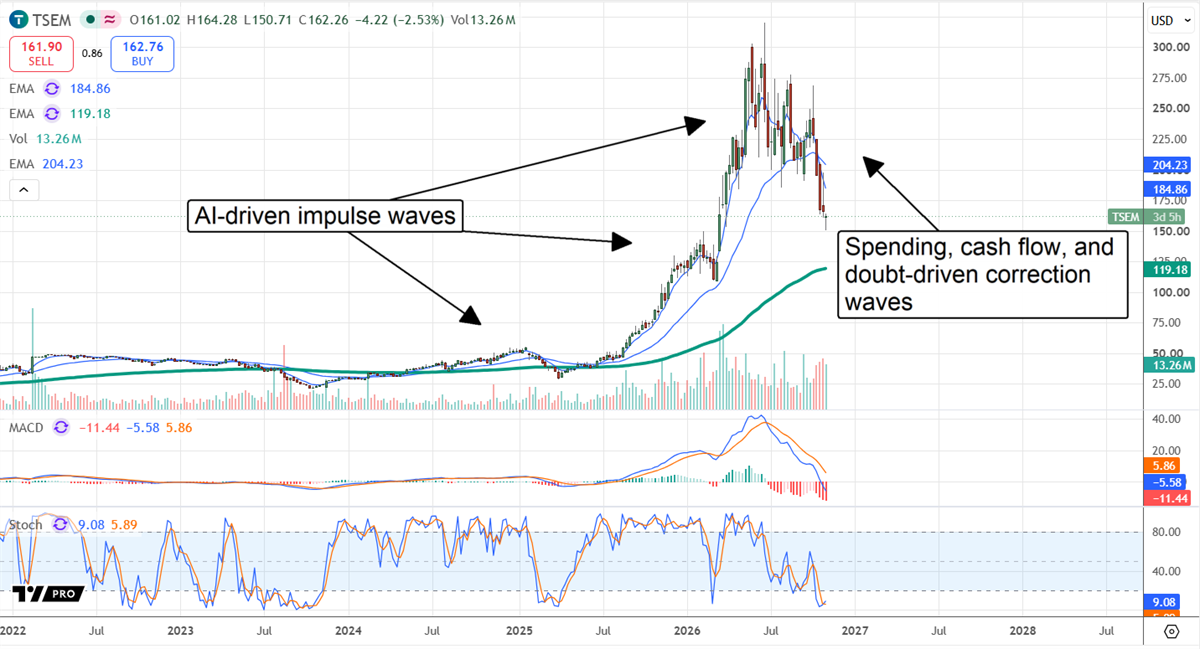
TSEM’s share-price action aligns with the thesis that the market is shifting from speculation to execution. Shares fell approximately 53% from their June 2026 peak to their Nov. 2 intraday low, a dramatic correction following an extraordinary multiyear rally. That rally began in late 2023 and continued through June 2026, forming a pattern that technical analysts might interpret as an Elliott Wave cycle.
Market sentiment remains clouded by fear and uncertainty, with profitable AI infrastructure companies like Tower facing selling pressure alongside more speculative, cash-burning AI businesses. Elliott Wave theory identifies recurring market cycles influenced by shifts in investor sentiment, including optimism, greed, fear, and doubt. Under this interpretation, Tower's steep correction could reflect the later stages of a sentiment cycle, potentially setting the stage for another rally.
Yet Tower's expanding capacity, accelerating revenue growth, and robust margins could help drive a recovery as investors increasingly distinguish companies delivering results from those relying on future promises. The AI buildout trade remains strong and could be poised for a second wind.
. |


No comments:
Post a Comment