 A Message From Porter & Company There are a lot of AI skeptics today, including several on my staff. Given the obvious parallels to the dot-com boom, I don’t blame them. And I agree in several ways too. So much so that I’m not recommending any of the major AI giants but rather a select group of companies that I believe could deliver far greater upside from the AI build-out. But here’s what the AI skeptics are missing: over the last 50 years, the most important, broadly applicable corporate moat was compute. And right now, that moat is getting wider, much wider, thanks to artificial intelligence. By compute, I mean three specific things:
- Computation (the speed and processing power of semiconductors).
- Digital memory (the ability to store vast quantities of digitized information).
- Bandwidth (how much and how fast information can be shared across a network).
When you break down virtually any business to its most basic elements, you end up with a sequence of decisions, all of which must be made with partially incomplete information. A firm that shrinks the possible outcome dispersion of its educated guesses earns more on every dollar of capital it deploys and can reinvest the difference into shrinking risks further. I know this works because I’ve done it often in my career. Steve Sjuggerud and I spent millions of dollars building proprietary databases between 2002 and 2019 to discover the patterns and correlations that drive the markets. At every step of my career as an investor, I’ve been trying to gain an information advantage (legally). I’m constantly seeking new ways to minimize risk. And the best way to do that is through investments in compute. The same is true for every great business. In 1987, Walmart finished building the largest private satellite communications network in the United States. It cost $24 million, took two and a half years to build, and connected more than 1,200 sites. Walmart founder Sam Walton was famously cheap. So what did he buy for $24 million? No more guessing. Every register in the chain reported what it had sold, overnight, to one building in Arkansas. By 1992, Teradata had built Walmart the first commercial data warehouse to cross a single terabyte. A competitor down the road reordered on a merchandiser’s instinct and a monthly report. Walmart reordered on Tuesday’s actual sales, store by store, item by item. That database was probably more valuable than Walmart’s physical stores. How do I know? Kmart was the larger discount chain by revenue when those satellites went up. By the time Kmart understood what the network was for, it was hopelessly behind. It never built a similar system and ended up in bankruptcy, mostly because of Walmart. Or look at AMR, then the parent of American Airlines. They spent roughly $40 million and 400 man-years building the Semi-Automated Business Research Environment with IBM. Known today as Sabre, it went live in 1960. A booking that normally took 90 minutes now took only seconds. What was worth more: all the airplanes and all of the routes, or the database? In March 2000, AMR spun Sabre off. AMR carried that stake on its books at about $600 million. The market valued it at $5.2 billion. The database was worth way more than the planes. Capital One Financial was founded on the premise that a credit card is not a product but an experiment. In 1999 alone, it ran 36,114 tests on pricing, terms, and solicitations. Its competitors mailed one offer to everyone at one price and wrote off the resulting defaults as a cost of doing business. Capital One stopped guessing. This is my message: There’s no such thing as a company that isn’t a tech company. If you’re not leading your field in applying compute, you risk going out of business over the next decade. There’s no such thing as a tech stock anymore. There are simply companies that are good at applying compute and companies that fail. But here is the most important part of this story… everything above happened while computation was scarce and expensive. It is now neither. Right now, Big Tech is pouring hundreds of billions of dollars into AI data centers. This massive infrastructure build-out is driving the cost of compute down to near zero. The companies building these data centers are financing these investments with mountains of debt. And that’s why the real wealth won't be made by the builders. It will be made by the companies that can absorb this hyper-abundant, near-free compute to completely rewrite their own economics. So the question is: which industry can absorb almost unlimited, near-free computing power and still defend its prices? We’ve found the answer. It’s a completely abandoned sector of the market that represents the largest computational puzzle on earth. More importantly, it’s the only industry where the government hands you a legal, federally enforced monopoly to protect your product for decades. I believe this sector is about to absorb the capex of the AI boom, and it could be among the best-performing sectors of the stock market… the next Magnificent 7. I lay out the entire roadmap, including what you need to consider selling immediately and exactly where this capital is rotating, in my new broadcast. Click here to watch before it’s too late. Good investing, Porter Stansberry
This Week's Featured Article
Tesla's Robotaxi Lands in Paris—But Europe's Real Fight Is Over Cheap EVsReported by Nathan Reiff. Article Published: 10/13/2026. 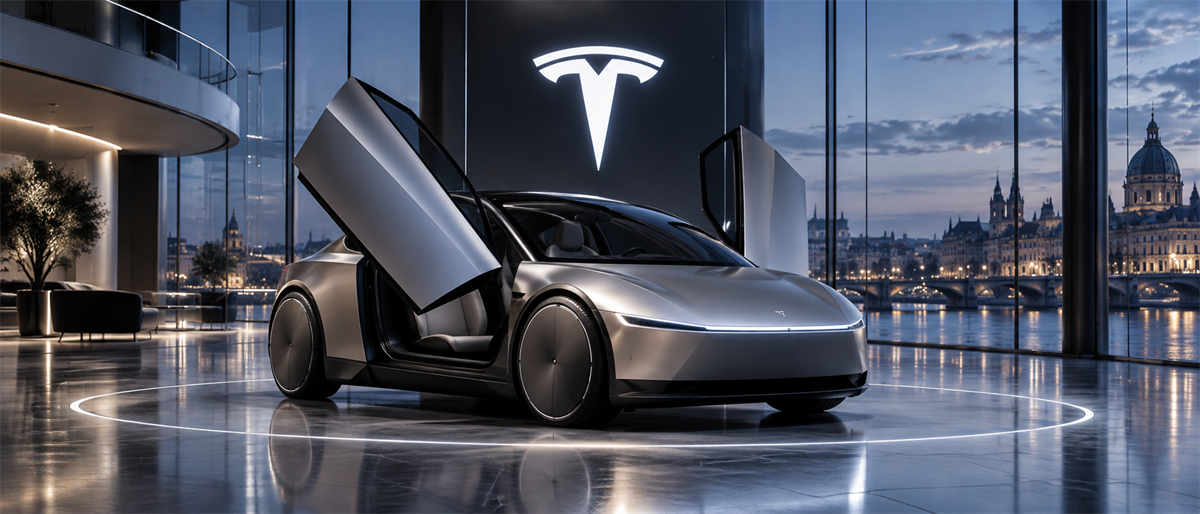
Key Points
- Tesla unveiled its Cybercab robotaxi in Europe at the Paris Motor Show while emphasizing its Full Self-Driving technology amid unresolved European regulatory approval.
- Stellantis, Renault's Dacia brand, and Chinese makers like BYD showcased competing strategies emphasizing affordability, local production incentives, and low-cost EV models.
- Investors should watch European incentive policies tied to vehicle manufacturing location and Tesla's upcoming Q3 earnings report for updates on FSD approval progress.
- Special Report: Rickards Predicts: Trump to buy tiny $2 stock?
Tesla Inc. (NASDAQ: TSLA) is sure to generate headlines at the Paris Motor Show as the electric vehicle (EV) giant unveils its Cybercab robotaxi in Europe for the first time. Looking more closely at Europe's largest automotive stage, however, investors may find that the bigger story is the broader push toward affordable EVs, with numerous competitors showcasing their latest models.
Stellantis N.V. (NYSE: STLA), for example, returns to the show with more than 60 vehicles across eight brands, while local automaker Renault Group (OTCMKTS: RNLSY) will showcase a Dacia Spring built in Europe and designed to meet local incentive requirements. Chinese competitors will also be in attendance as they seek to broaden their appeal across the continent. The contrast between these offerings highlights the different strategies companies are using to win Europe's coveted EV market—from autonomous-driving technology to low-cost alternatives that take advantage of local opportunities. Tesla Makes a Big Bet on Autonomous DrivingTesla is offering test drives in multiple vehicles equipped with the company's Full Self-Driving (FSD) system, though not in the Cybercab. The decision represents a clear effort to emphasize what the company sees as a technological advantage, potentially putting that message ahead of vehicle pricing and specifications. However, European regulations surrounding autonomous driving remain a critical factor for Tesla and continue to evolve. That may be why the company is also highlighting FSD Supervised, its driver-assistance technology, at the auto show. The vehicle authority of the Netherlands granted limited approval for FSD Supervised earlier this year, although the system is not yet approved across all of Europe. Nonetheless, approval for a driver-assistance platform is very different from approval for a fully self-driving system. Tesla still needs to convince European regulators of the safety and viability of its goal. One of the company's latest efforts to do so is to drop the FSD name entirely in favor of "Assisted Driving." Stellantis Attempts to Win Back European BuyersEuropean firm Stellantis has a new leader in CEO Antonio Filosa, along with a renewed emphasis on its extensive portfolio of brands and a push to reconnect with European customers. Its display in Paris includes vehicles ranging from Fiat and Opel to Peugeot, Alfa Romeo and Citroën, as well as new products and concepts intended to show how the company is transforming its traditional brands into EV competitors. The scale of Stellantis' display suggests the company is going all-out to rebuild momentum among European customers as it faces increased pressure from Chinese EV makers and the cost of transitioning its many vehicles to electric power. To succeed in that transition, Stellantis will need to make electrification accessible to European customers without losing the perception of quality long associated with its brands. The company will need to turn its product launches into sales while keeping a close eye on margins. A Lesser-Known Brand With Affordability AppealRenault's Dacia brand is offering a redesigned Spring electric city car at the show, providing another response to the affordability challenge facing EV makers. The model is produced in Europe, while the previous version was built in China, helping it qualify for European incentives that favor domestically produced vehicles. Taking advantage of local incentives can help Renault keep the purchase price of the Dacia Spring down without absorbing all of those costs itself. Incentives can play a significant role for buyers, as well. Renault is relying on pricing and production decisions to make the economics work, rather than leaning on brand recognition as Stellantis is doing. Chinese Competitors Bring Low-Cost OptionsChinese makers like BYD—trading over the counter in the United States as BYD (OTCMKTS: BYDDY)—are pressuring European rivals with low-cost EVs, including several new products unveiled at the Paris show. BYD is presenting the Atto 8, a seven-seat electric SUV that the company claims can charge from 10% to 97% in nine minutes under optimal conditions. EV makers in China have sought to corner the entry-level EV market, but the Paris show may reveal competition at other price points as well. The show could also provide an opportunity to highlight the AI tools and autonomous-driving technology these companies have developed. What to Watch Going ForwardInvestors should keep an eye on how European governments reshape the competitive landscape for EV makers through incentives linked to where cars are built. Such programs could narrow the price gap between European-made EVs and imported rivals. Requirements differ by country, however, creating a complex system that may not produce clear winners. For Tesla, a major catalyst will be its Q3 earnings report in the week following the Paris show. Investors will be watching for updates on cash generation, capital spending, margins and more. Any progress on FSD approval will likely draw attention as well. . |


No comments:
Post a Comment