 A Message From Monument Traders Alliance Jensen Huang said a little-known corner of the AI world is a “once-in-a-generation opportunity.” As you probably know, he's the CEO of NVIDIA, the top AI chip company in the world. Strangely, this “once-in-a-generation opportunity” has nothing to do with cutting edge AI chips, programs like ChatGPT, or data center buildouts. Instead, it involves AI breaking free of computers and the internet to work right beside us in the real world. And that’s why Jensen Huang also called it "the dawn of a new industrial revolution." What is he talking about? See the story, including details on my #1 pick in this exciting space.

NVDA CEO’S “ONCE IN A GENERATION OPPORTUNITY” REVEALED To your wealth,
Matt McCall P.S. I called NVDA, back when it was $6. It has shot up 3,100% in 6 years. So, I think NVDA’s CEO knows what he’s talking about. Click here for more details.
Further Reading from MarketBeat
Big Banks Report Strong Earnings—So Why Are Shares Falling?Submitted by Dan Schmidt. Article Published: 10/15/2026. 
Key Points
- Wells Fargo, Goldman Sachs, and Citigroup released third-quarter 2026 results on Oct. 13 amid uncertainty following the Federal Reserve's latest rate hike.
- Despite management expressing optimism and strong headline numbers, including Goldman's record advisory fees and Citigroup's decade-high Q3 revenue, investor reaction was largely negative.
- Forward-looking guidance drove the sell-off, as Wells Fargo kept its NII forecast flat and Citigroup warned of a potential 20% drop in Markets revenue next quarter.
- Special Report: The REAL Reason Trump is Invading Iran
It’s earnings season in the finance sector, and many banks are reporting earnings for the first time since the Federal Reserve's first interest rate cut since 2023. The cut was unanimous at 12-0, but the next move is anything but certain as we head into Q4. That uncertainty is weighing on banks as they report Q3 results this week, and on Oct. 13, we got results from Wells Fargo & Co. (NYSE: WFC), The Goldman Sachs Group Inc. (NYSE: GS), and Citigroup Inc. (NYSE: C). Although the rate cut came too late to affect Q3 results, it still forces banks to update their outlooks, and their guidance and projections can offer investors clues. Management at all three banks expressed optimism, but the market’s response to the results told the real story. Wells Fargo: The Beneficiary in Waiting
Wells Fargo is the most deposit-focused of the three and is expected to benefit the most in a rising-rate environment. But investors looking for optimistic guidance probably weren’t thrilled with management’s full-year projections. The company reported its fiscal Q3 2026 results before the market opened and posted a slight beat on earnings per share (EPS), but revenue missed and rose only 2% year over year (YOY). Net interest income (NII) rose 5% YOY to $12.52 billion, and CFO Mike Santomassimo explicitly cited the rate environment as a net positive for the company heading into Q4. But despite the positive commentary, management projects $13 billion in NII for Q4 and left its full-year 2026 NII projection unchanged at $50 billion. The Q4 figure would represent 4% sequential growth, but Santomassimo noted that Markets NII is liability-sensitive, which could offset some fee growth in Q4. And while NII growth was strong, net interest margin was flat sequentially at 2.43%. 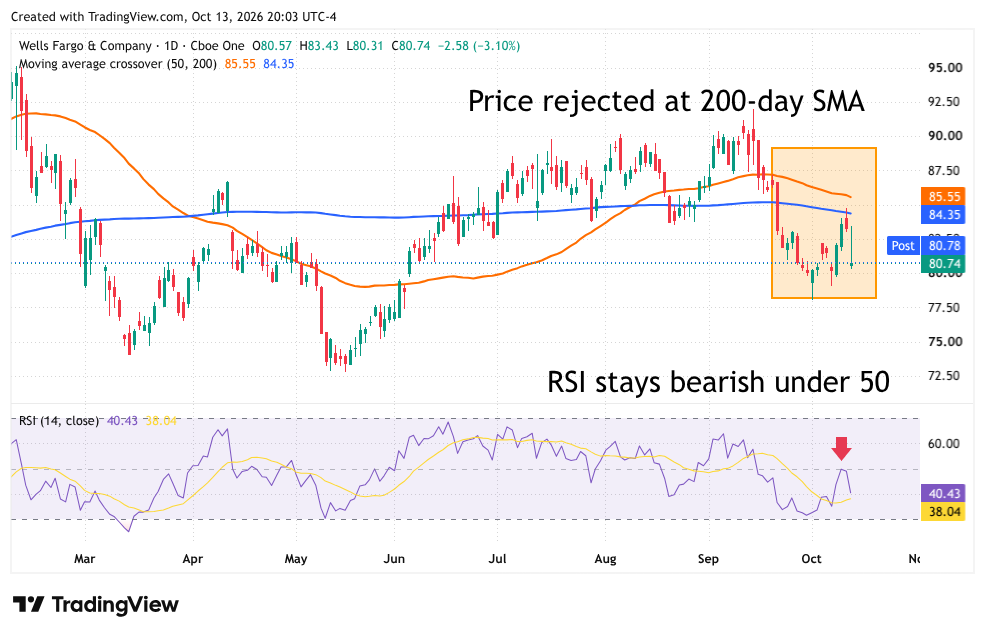
Wells Fargo’s core revenue streams likely make it a winner in a high-rate environment, but the market didn’t respond well to management's “just trust me” guidance heading into Q4. The stock ended the day down 3%, but the price rejection at the 200-day moving average could have a longer-term impact. With the company saying rate benefits are essentially being pushed into 2027, investors see a shaky road ahead for WFC shares, and the Relative Strength Index (RSI) staying below 50 suggests buyers are starting to thin out. Goldman Sachs: Dealmaking Squeeze Isn’t MaterializingHigh rates don’t affect every bank equally. Wells Fargo expects rising rates to be a net positive since it earns more interest from loans. But what about banking activity that high rates can hurt, such as mergers and acquisitions? A dealmaking slowdown was the biggest concern heading into the Goldman Sachs report, but those fears proved largely unfounded. In fiscal Q3 2026, the company reported revenue of $18.68 billion, the second-highest figure on record and 23% higher than the same period a year ago. EPS of $17.01 also shattered the consensus expectation of $12.86 and exceeded $18 per share when charitable contributions were excluded. Investment banking fees rose 21% YOY to $3.22 billion, and advisory fees hit a record $1.65 billion. But the dealmaking engine keeps churning, and this optimism likely helped the stock outperform its peers that also reported on Oct. 13. CEO David Solomon noted that Q3 began with dealmaking activity at a five-year high and remained robust despite a late-quarter slowdown that pushed back several high-profile IPOs. The company has announced more than $1.5 trillion in M&A so far in 2026, which is more than $400 billion above the next-closest competitor. Rate volatility could still impact dealmaking in future quarters, but current deal flow remains strong. 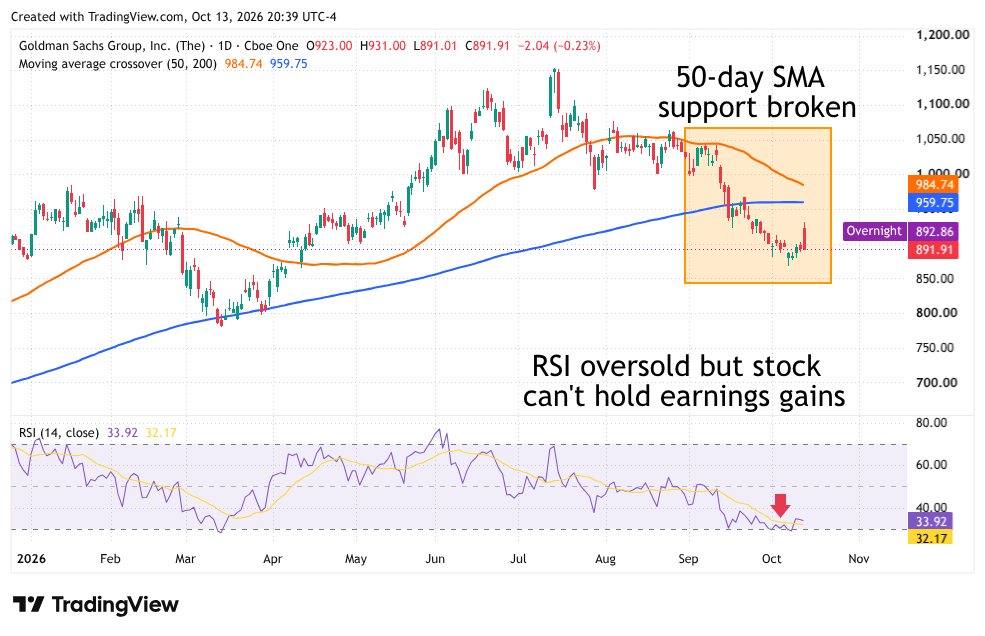
GS shares started the day up nearly 5% before giving back all their gains and then some, closing down 0.17%. This was the best performance of the three, but it's notable given Goldman’s strong earnings relative to the two deposit banks. Despite the RSI hitting extremely oversold levels, the stock's decline below the 50-day and 200-day moving averages dampens short-term momentum, and the market needs more rate clarity before this trend can reverse. Citigroup: Strong Quarter That the Market Sold AnywayCitigroup could be considered the hedge between Wells Fargo and Goldman Sachs. The bank should benefit from higher rates through NII growth, but trading fees should also grow with market indices near all-time highs. In fiscal Q3 2026, both engines appear to be working. Citigroup reported its highest Q3 revenue in more than a decade at $23.85 billion, up 8% YOY. NII ex-Markets grew 7% YOY to $13.71 billion, while Markets grew 6% and Investment Banking grew 9%. Management also raised its full-year 2026 NII ex-Markets guidance to the mid-to-high 6% range, up from the 5% to 6% range it projected earlier in the year. Citigroup raised its NII projections while Wells Fargo left them unchanged. So why did Citigroup’s stock get punished more that day? The answer lies further in the guidance. CFO Gonzalo Luchetti expects Q4 Markets revenue to decline 20%, “or possibly more,” from Q3, and U.S. Consumer Card revenue was flat during the period. Luchetti says the guidance could be conservative, but the market disliked the news, and the stock fell sharply during the day, closing down more than 5.5%. 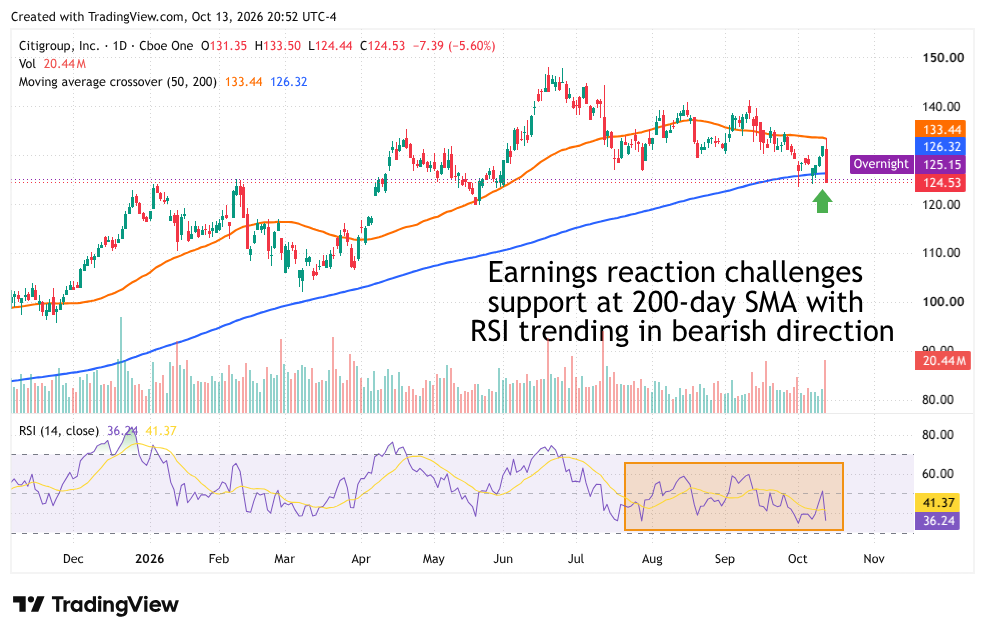
Despite the poor earnings reaction, C stock still has the most promising chart. The stock closed right at the 200-day moving average, keeping the long-term trend pointing in the right direction for now. However, the RSI is trending down, and investors are likely pricing in a quiet Q4 ahead of the next rate move.
This ad is sent on behalf of The Oxford Club. 105 W Monument St, Baltimore, Maryland 21201. If you would like to optout from receiving offers from The Oxford Club please click here
|


No comments:
Post a Comment