A Message From Porter & Company Editor's Note: Porter Stansberry's bombshell exposé is now live. Sitting down with financial reporter Kimi Weintraub, he reveals why he believes President Trump is secretly replacing the U.S. dollar – and why the story could break wide open on December 14. He also names his No. 1 move to help you prepare. Watch it here before you read another word.
In the autumn of 408 A.D., a Gothic king named Alaric marched his army to the walls of Rome and simply waited. He didn't need to storm the city. He cut off the grain barges coming up the Tiber, and within weeks the richest city on Earth was starving. His price for leaving was thousands of pounds of gold, tens of thousands of pounds of silver, and three thousand pounds of pepper. Rome no longer had it. So the Senate stripped the temples and melted down the statues of their gods to pay him. According to the historian Zosimus, one of them was Virtus, the goddess of courage, and once she went into the furnace, whatever courage the Romans had left went with her. Two years later Alaric came back and walked straight in – for the first time in eight hundred years, Rome was sacked by a foreign army. Rome had been brought to its knees because it allowed its money to go to ruin.
For two hundred years before Alaric arrived, emperor after emperor had shaved the silver out of the denarius to pay for their wars – until the coin that was once trusted from Britain to Babylon was a lump of bronze with a thin silver wash. By the time the Goths reached the gates, Rome's walls were still standing, but its money had already given way. Today, America faces its own barbarians at the gate. China’s Silent Siege The new Barbarians aren't camped outside Washington – like Alaric, they don't need to storm the capital, they're simply waiting for the money to fail. China has slashed its holdings of U.S. Treasuries by more than 45% from their peak. It controls the vast majority of the world's refined rare earths, the metals without which no advanced chip or weapon can be built. And it is building gold vaults in Hong Kong and payment networks that let nations trade without ever touching a dollar. Beijing is cutting off the grain barges, and now it's waiting at the walls. A Cycle Nobody Escapes If you study enough history, you start to see that Rome's fate was not bad luck. It was a repeating pattern, and nearly every great power since has followed it. Kublai Khan's paper money was printed into worthlessness to pay for his wars, and in 1368 his dynasty was driven out of China. Weimar Germany ran through the whole cycle in barely five years, until a single U.S. dollar fetched more than four trillion marks. Each empire borrowed beyond its means, debased its money , and watched its allies drift away until the barbarians arrived. America is speed-running toward the same fate. If your family had set aside a dollar when the Federal Reserve opened in 1913, it would buy about three cents' worth of goods today. 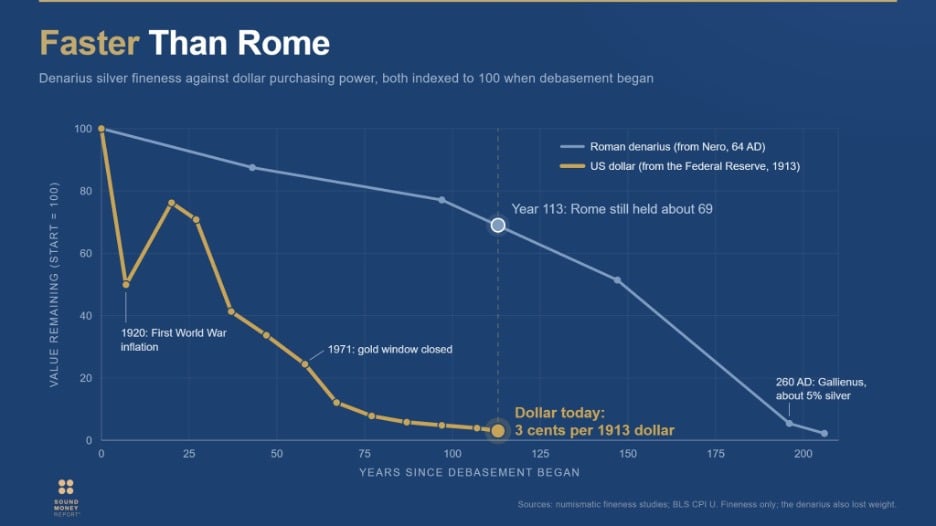
By all rights, the dollar should have gone the way of the denarius long ago. What saved it was a secret deal Henry Kissinger struck with Saudi Arabia in 1974: the world's oil would be priced in dollars, so every nation that needed oil had to hold dollars too. It was the modern equivalent of Rome's grain supply, except America controlled the barges. That arrangement bought time, fifty years of borrowing on the rest of the world's tab, and created staggering fortunes for those who owned the companies the new money flowed through. ExxonMobil climbed 9,700% in the decades that followed, JPMorgan 6,000%, Lockheed Martin 14,400% and Microsoft 479,000% – extraordinary price rises unleashed by the petrodollar era. By some estimations, America went from roughly 180,000 millionaires in 1974 to nearly 24 million today. But Washington never stopped clipping the coin. The dollar has lost more than 84% of its purchasing power since that deal, and in June 2024 the petrodollar arrangement quietly expired. Ask almost any historian or economist how this ends, and they'll tell you the same thing. No empire has ever escaped the cycle. Trump's Secret Dollar Reset Instead of melting down the statues, President Trump is trying to give the world a new reason to need the dollar. Working hand in hand with the likes of Elon Musk, Mark Zuckerberg and Sam Altman, he is racing to lock the physical foundation of artificial intelligence (the minerals, chips, energy and data centers) under near-exclusive American control. That's why the government has taken billion-dollar stakes in obscure mining companies, why the President negotiated a reported $500 billion of Ukraine's minerals, and why he refuses to let go of Greenland. It's also why, on September 30, 2026, he announced what he called one of the largest energy infrastructure investments in American history: a $22.3 billion natural gas power complex in Texas built to feed AI data centers, alongside a framework for eight new nuclear reactors. Seen together, I believe these emergency moves are the foundations of a new monetary order, with the dollar anchored not to oil but to what I call the AI Matrix. The companies at its chokepoints are already moving the way ExxonMobil and Lockheed did half a century ago. Vertiv is up more than 500% since 2024, GE Vernova nearly 700% and Arista Networks more than 750% since 2021. Whether Trump's gambit succeeds or fails, I believe it will draw a dividing line through this country, just as the petrodollar did. On one side will be the people who own the assets that will benefit from the new monetary order. On the other, those whose plans and portfolios get left behind. I won’t mince my words: I believe getting on the right side of this change to America’s money might be a critical way to protect your family's wealth, long-term. To help you understand the magnitude of what’s unfolding – and how it could impact your money directly – I recently laid out the full story for financial reporter Kimi Weintraub. In our in-depth interview, I explain why December 14 could be the moment this new order is revealed. I also share the five companies I believe sit at its narrowest chokepoints, and the name and ticker of my No. 1 move to make today. Watch the full interview here. 
Good investing, Porter Stansberry
More Reading from MarketBeat
How a Hurricane Could Help Some Refineries—and Hurt OthersAuthored by Nathan Reiff. Publication Date: 10/14/2026. 
Key Points
- Hurricane Isaias showed that storm impacts on energy stocks depend on asset location, revenue diversification, and exposure to widening crack spreads.
- Chevron shares rose about 4% in the past month after Isaias proved less damaging than feared, while diversified Phillips 66 gained 14%.
- The VanEck Oil Refiners ETF, up roughly 80% year to date, benefits from global diversification and tighter refined markets caused by Gulf Coast disruptions.
- Special Report: Rickards Predicts: Trump to buy tiny $2 stock?
Hurricane season in the United States can be a major driver of volatility in the energy sector, though investors tend to overlook the nuances that can leave some companies heavily affected while others are barely impacted. When storms threaten the Gulf Coast, there is always the possibility of refinery closures, production disruptions, infrastructure damage and resulting increases in prices at the pump. Early October's Hurricane Isaias recently demonstrated how difficult it can be to predict the impact of these events. While forecasts initially called for Isaias to affect a wide area of Gulf Coast refineries, the amount of refinery capacity expected to be impacted shrank considerably as landfall approached. For investors, the disruption to energy companies in the area may ultimately have been less severe than expected, but the storm still offered lessons on how to identify opportunities. The impact of a hurricane on any specific company generally comes down to where its assets are located, how diversified its revenue streams are and whether it can benefit from the widening crack spread that often occurs after refining capacity is reduced. Isaias Didn't Need to Destroy Refineries to Disrupt the Market
As Isaias demonstrated, even if a hurricane causes less damage than initially anticipated, it can still create volatility in the energy market. Companies may choose to reduce production or even shut down portions of their businesses preemptively. Investors were watching facilities such as Chevron's (NYSE: CVX) refinery in Mississippi, a major domestic facility that faced potential flooding or outages as a result of the storm. While CVX shares remained flat from late September through Oct. 7, they quickly climbed as it became clear that Isaias would likely cause less damage than originally expected. CVX is up about 4% in the last month. By contrast, shares of rival Phillips 66 (NYSE: PSX) have risen 14% in the last month, signaling investor optimism about a company that was less likely to be affected by Isaias' path from the outset. Phillips is a nuanced play in a scenario involving a Gulf Coast hurricane, given its diversified business lines. The company has refining, midstream, chemicals and other businesses, some of which are significantly more exposed to hurricane-related risks than others. While PSX shares are up an impressive 125% year to date (YTD), this performance largely reflects the expansion in crack spreads that has benefited refiners broadly amid the ongoing Iran conflict, rather than a specific response to Isaias or other weather events. Phillips' midstream business is critical because it provides cash flow based primarily on fees rather than crude prices, which may make PSX more stable during future hurricanes. Chevron's Crude Production Could Be Interrupted, But at What Cost?In addition to Chevron's Mississippi assets, the company's deepwater Gulf of Mexico operations face the risk of temporary shutdowns during severe storms in the area. This could affect not only the company's refining operations but also its crude production volumes. Still, with crude prices as high as they are, the revenue impact of a brief production interruption is less damaging. Indeed, a crude price spike following a hurricane, as occurred during Isaias, can help offset those losses further. CRAK Benefits From 3 Distinct TailwindsThe VanEck Oil Refiners ETF (NYSEARCA: CRAK) is an exchange-traded fund (ETF) that holds a basket of global oil refiner stocks, with domestic names making up just 35% of the portfolio. Even if those stocks are affected by a North American hurricane, the bulk of the portfolio should remain unaffected. At the same time, virtually all of the companies in CRAK's portfolio could benefit from a tighter global refined-products market caused by a disruption along the U.S. Gulf Coast. Setbacks for domestic refiners may create opportunities for international rivals. CRAK's net assets have surged dramatically this year as investors have capitalized on wide crack spreads and rapid share-price increases among refiners. The fund has generated year-to-date returns of about 80%, making its relatively high expense ratio of 0.61% more tolerable. However, not all of the current tailwinds—limited supply due to the Iran war, elevated crack spreads and reduced Gulf Coast capacity—are likely to continue over the long term. Crack spreads tend to normalize within a few weeks of a U.S. hurricane, so investors new to CRAK should keep in mind that they may be buying after the Iran war has already delivered significant returns and as hurricane season approaches its end for the year. . |