 A Message From Awesomely Thanks to a new law Trump just signed… Every day until April 2027 the entire GDP of Switzerland will migrate onto Trump's New Money Grid, that's $909 billion. Every single day. That's every bank account, every fund, every mortgage, every stock trade in America. Translation: our entire financial system is migrating onto a new blockchain-based Money Grid. And every dollar that moves burns one scarce asset. That's why BlackRock, JPMorgan, Goldman Sachs and Fidelity are hoarding shares like it's Black Friday. Get in on the trade BlackRock, JPMorgan, and Fidelity are already making. The Nasdaq just got SEC approval to move stocks onto blockchain rails. BlackRock CEO Larry Fink dedicated his entire 2026 annual letter to it. The World Economic Forum says 2026 is "a defining moment" for this new financial infrastructure. Everyone who's actually building this thing is saying the same thing… This is not a drill. This is the biggest overhaul of America's money system since we stopped using gold coins. And at the center of it all? A scarce asset that gets burned every single time a transaction happens. Block Chain expert Andy Howard is calling it "Digital Oil." And right now, before this goes mainstream, you can still get in at prices the institutions would love to lock in forever. Get the name. The ticker. And exactly how to buy here. Your future looks bright, Andy Howard
The Edge™ Senior Blockchain Analyst PS I'm predicting this could potentially be one of, if not THEE most explosive wealth opportunities I've come across. That's why you can't drag your feet here, because once retail investors catch wind of this, it will be too late… Click here before it's too late to get in on the trade.
Today's Bonus News
Eli Lilly Keeps Pulling Ahead—Can Novo Nordisk Catch Up?By Thomas Hughes. Date Posted: 9/23/2026. 
Key Points
- Eli Lilly holds a larger, growing GLP-1 market share and longer patent exclusivity, leaving Novo Nordisk's growth plan unable to impress investors.
- Analyst sentiment favors Eli Lilly, rated a Moderate Buy with rising price targets, while Novo Nordisk has fallen to Hold amid declining targets and coverage.
- Novo Nordisk's approval decision for CagriSema, expected in the fourth quarter, could extend its revenue runway, though lawsuits over GLP-1 side effects pose additional risk.
- Special Report: Why most people ignore my “boring” stock picks
To determine whether Novo Nordisk (NYSE: NVO) is closing the gap with competitor Eli Lilly (NYSE: LLY) in the GLP-1 market, investors need only consider patent-cliff timing and current market share. Eli Lilly commands a larger and growing share of the market and is positioned to retain exclusivity for years longer than Novo. In this scenario, Novo has little choice but to lose ground, which is why the long-term plan it laid out at its September Capital Markets Day failed to inspire investors. Novo's pipeline includes more than five drugs with "multi-blockbuster" potential by 2030, more than $23 billion in pipeline sales by 2035, and enough manufacturing capacity to treat 10 times more obesity patients with oral GLP-1s. The question is whether it can turn that pipeline into sales, and the outlook is dim, relatively speaking.
The signal for investors is that the plan promises only to sustain the business over time—an offset to looming GLP-1 weakness rather than a driver of premium growth. With premium performance no longer part of the outlook, there may be little justification for a premium in the stock’s price. With executives forecasting growth in line with industry trends, investors can expect the stock to languish near its lows until a new reason to buy emerges. Is the Obesity Trade Over?The obesity trade isn't over, but it has matured into a new era. The space is no longer a pure duopoly; competition is emerging, analysts are forecasting price erosion, and Novo’s own results reflect that shift. The risk for the company is disruption, and it needs a hit product just to retain its number two position. For now, the market is focused on the winner: Eli Lilly. 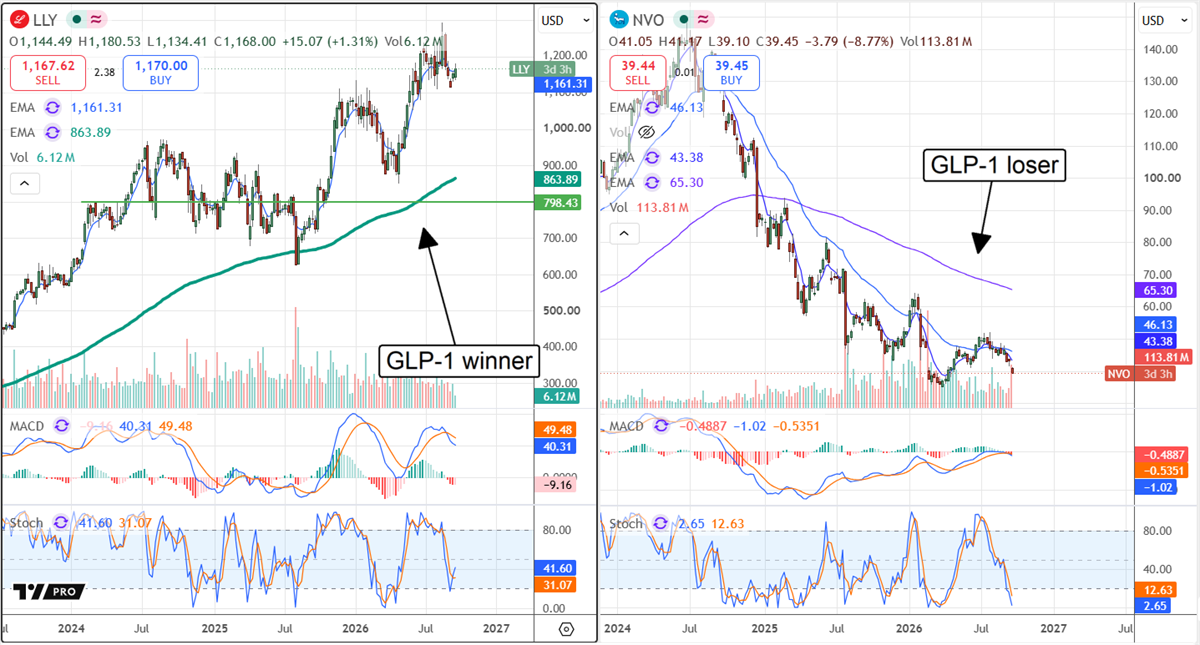
Novo Nordisk’s first-mover advantage is gone. Eli Lilly not only created a better molecule, with stronger results and better tolerability, but also managed a flawless rollout and scaled production to meet demand. It outperforms Novo Nordisk’s drug in head-to-head trials, while Novo continues to struggle with capacity ramps and has failed to capitalize on its position. Eli Lilly now commands more than 60% of the market, outsells Novo Nordisk by more than two to one, and has a stronger pipeline. Eli Lilly’s pipeline is massive, funded by its still-growing GLP-1 cash haul. Its GLP-1 candidates include a triple agonist, compared with its current double-agonist and Novo Nordisk’s single-agonist approaches. The company aims to reduce average weight by up to 25%, potentially cementing its leadership position for years to come. Other candidates include several with blockbuster potential, such as Kisunla for Alzheimer’s and a once-weekly basal insulin solution for diabetics. If approved, that weekly insulin could revolutionize a niche within the diabetes market, disrupting another business in which Novo Nordisk has a first-mover advantage. Analysts' Trends Highlight the Opportunity … in Eli Lilly SharesAnalyst trends summarize the difference between these stocks, highlighting one to shed and the other to accumulate. While sentiment toward Novo Nordisk isn’t outright bearish, analyst coverage is deteriorating, with 18 analysts covering it compared with 30 covering LLY. Novo's sentiment rating has fallen to Hold; a few Sells have been logged, and price targets are declining. The consensus price target still forecasts solid upside, but the trend matters—and it pushed NVO shares to the low end of the range in late September. The risk now is that analysts' trends continue to sour, leading the market to set lower lows. Eli Lilly analysts, on the other hand, rate LLY as a Moderate Buy by consensus, with conviction strengthening. MarketBeat tracks 30 analysts covering the stock; the data shows an 86% Buy-side bias, and price targets are rising. Consensus offers only modest upside, but again, the trend matters—and it points to the high end of the range, more than 22% above the late-September consensus. The likely outcome is that analysts will remain bullish on this stock into 2027, underpinning its uptrend and keeping pressure on NVO. CagriSema Could Be Novo Nordisk’s Next Major CatalystNovo Nordisk’s next catalyst is coming soon. The company expects regulatory approval of CagriSema, a next-generation combination weight-loss treatment. It targets a dual-mechanism advantage, using amylin analogs to promote feelings of fullness. The hope is to break through the weight-loss plateau many GLP-1 users experience. If successful, it could help Novo retain its position in the weight-loss market, potentially driving outperformance and improving market sentiment in the coming quarters. What the market may be getting wrong is CagriSema’s impact on the patent cliff: It is based on Wegovy but combines it in a new way, potentially extending the revenue runway for many years. The approval decision is expected in Q4 this year. Aside from lost market share, Novo's biggest risk is the growing number of lawsuits tied to its GLP-1 agonist. The lawsuits allege severe gastrointestinal side effects and a failure to provide adequate disclosure, which could hamper the business moving forward. If the allegations prove true, users could flock to Eli Lilly’s solution or another competitor's, driving the business into decline.
If you no longer wish to receive these emails, unsubscribe here.
. |


No comments:
Post a Comment