 A Message From TradeWins Ian Cooper here... It’s devastatingly simple. But it’s working. It’s a simple trade where we target a triple-digit return in just 9 days. It doesn’t work every single time, of course. But the win rate (73%) and the return on capital (2,671%) stand on their own. I’ll show you the strategy AND I’ll even give you my newest report at no charge right here: The Simple Path: Target triple-digit returns in just 9 days In your corner, Ian Cooper
Friday's Featured Story
Stitch Fix Stock Plunges as Guidance Puts the Turnaround on PauseAuthored by Chris Markoch. Article Posted: 9/28/2026. 
Key Points
- Stitch Fix returned to full-year revenue growth in fiscal 2026, but its fiscal 2027 outlook points to flat-to-negative growth amid a more challenging consumer environment.
- Stitch Fix continues to improve client economics and retention, even as its active-client base remains under pressure.
- Stitch Fix shares plunged after earnings, leaving the stock technically oversold but with investors waiting for evidence that the turnaround can resume.
- Special Report: Exclusive offer: you can't get this anywhere else
Shares of Stitch Fix (NASDAQ: SFIX) fell about 25% in morning trading on Thursday, Sept. 24, after the company announced its fourth-quarter earnings for fiscal year 2026 (FY2026). The issue wasn't the results, which were solid, but the guidance. In Q4 FY2026, Stitch Fix delivered revenue of $324.42 million, up 4.2% year over year (YOY). That was slightly below the consensus forecast of $325.5 million but higher than the $311.23 million it posted in the same quarter a year earlier. It was also the company's sixth consecutive quarter of YOY revenue growth.
For the full year, Stitch Fix delivered 6.4% YOY revenue growth. That was the first time the company had delivered full-year revenue growth since 2021. The company also generated $19.8 million in free cash flow. It ended the year with $220.9 million in cash and investments and no debt. The stock is plunging because the company is forecasting that this year's YOY revenue growth may not continue. However, with SFIX trading near its 52-week low, could this be a case of a stock looking so bad that it's actually good? Guidance Puts the Turnaround Story on HoldSFIX is under pressure because full-year fiscal 2027 guidance called for revenue between $1.31 billion and $1.36 billion. The midpoint of that range, around $1.335 billion, is lower than the approximately $1.35 billion in revenue the company delivered in 2026. In the earnings release, management cited a "more challenging consumer environment" as a key reason for the lower forecast. Like many companies, including McDonald's (NYSE: MCD) and Dollar General (NYSE: DG), Stitch Fix is pointing to consumers who continue to be choosy with their discretionary spending. Management also flagged two self-inflicted issues that will weigh on the first quarter. First, the company moved some Fix shipments into Q4, pulling volume forward from Q1. Second, an unintended change to its post-checkout flow in August limited the number of clients who could request another Fix. Management says the error has been corrected and won't affect results beyond Q1. Stitch Fix also plans to spend more on advertising and technology, including artificial intelligence. That's a bet on long-term growth, but it will pressure near-term margins. Investors were hoping the turnaround was gaining momentum. Instead, they got a forecast that looks like a pause. A Good Model With a Poor MoatThe Stitch Fix model is simple and convenient. Customers provide the company with information about themselves, including their lifestyle, measurements and the types of items they're looking for. The company also has a style tool that allows customers to "self-select" their preferred styles and colors. For a $20 fee, customers receive a curated "Fix" at home. They can choose to keep some, all or none of the items. If they choose none, the only cost is the $20 fee. If they keep anything, the fee is credited toward their purchase. Furthermore, customers can choose how frequently they receive their orders and even request a Fix on demand for upcoming events. It's a convenient model for the right customer. But maybe it's too convenient. When customers need to cut items from their budgets, subscription services are low-hanging fruit. To be fair, that's not exactly what the company is reporting. It's not losing customers at the pace it once was. Active clients fell 1.4% YOY to 2.277 million in Q4. That was far better than the 19.6% drop in 2024. But it's not building on that base, either. That puts a lot of pressure on existing customers to buy more. So far, they have. Revenue per active client rose 7.8% to $592. Client retention also improved for the eighth consecutive quarter. The question is how long existing clients can carry the load if their budgets are stretched. What the Chart Says About SFIX StockThe post-earnings gap lower pushed SFIX decisively below $3. That level had acted as support in March and May. The stock had already slipped below it in September, and the earnings report confirmed the breakdown. The trend is clearly bearish. The 50-day simple moving average (SMA) has been falling since early August and sits at $3.43. SFIX now trades more than 35% below that line. The rallies in April and June both stalled between $4.10 and $4.50, marking the ceiling that bulls would eventually need to clear. The one bullish signal is momentum. The relative strength index (RSI) dropped to about 24, well below the oversold threshold of 30. The last time RSI sank this low, in February and March, SFIX built a base near $3 for about two months before rallying above $4. Still, oversold is not the same as a bottom. Volume was already elevated by mid-morning, suggesting the selling may not be finished. 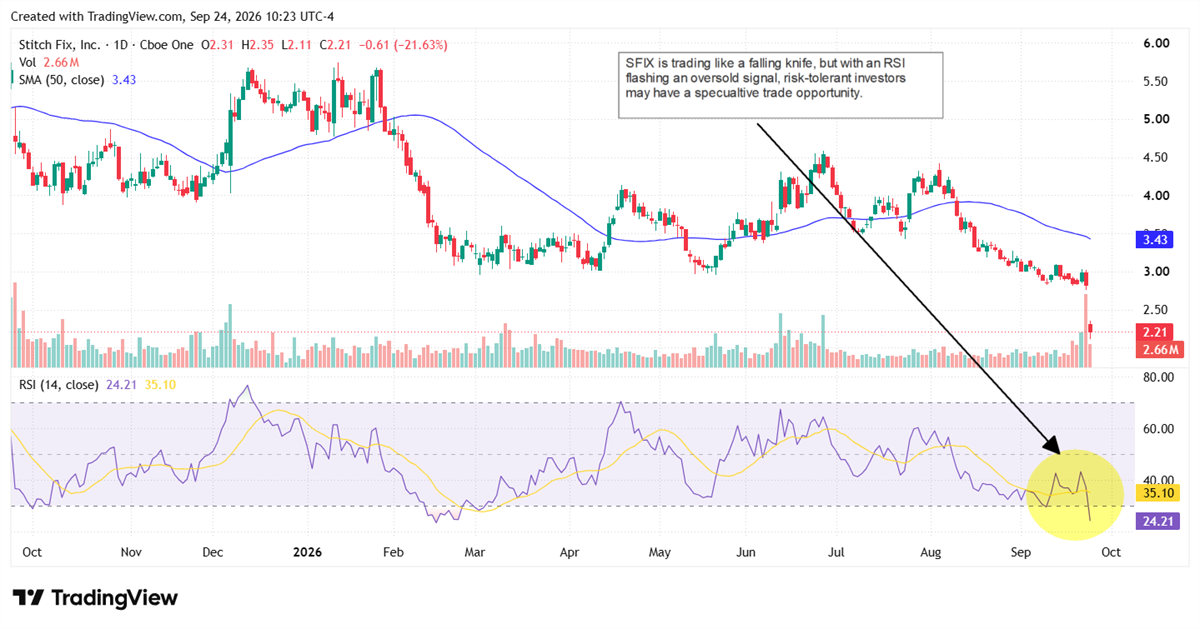
Stitch Fix Is a Cautionary Tale, But It's Not a Fairy TaleInvestors are wrestling with a stock that's down more than 93% over the last five years. But the more significant question is whether SFIX should ever have risen above $95 per share, as it did in 2021. Investors who took a position in the stock around that time and thought the sky was the limit are likely hurting badly. Like many stocks at that time, Stitch Fix was a pandemic momentum stock play. It's not that there wasn't any logic behind the stock's rise. In-person shopping was not an option for many customers, and the model met the moment. But the company wasn't profitable then, and it's still not profitable now. The gap, however, is much smaller. Stitch Fix lost $2.1 million in Q4 on a GAAP basis and posted adjusted EBITDA of $10.8 million. In 2022, it lost $207 million. Putting a $95 price tag on the stock was a fairy tale. With the stock trading near multi-year lows, SFIX is a cautionary tale that rests on the mindset of the consumer. The turnaround has made measurable progress, but the fiscal 2027 outlook puts the burden back on Stitch Fix to prove it can stabilize its client base and resume sustainable revenue growth.
NOTICE: Auto-trading, or any broker or advisor-directed type of trading, is not supported or endorsed by Ian Cooper. The information provided by Ian Cooper in its various materials, including trading recommendations, newsletters and educational publications is not customized or personalized for any particular person or risk profile. Past results are not necessarily indicative of future results. Results presented can vary and may not be typical for all subscribers. There are substantial risks involved with investing in the stock and options market, including the risk of total loss. You should only trade or invest "risk capital" - funds you can afford to lose.
NOTICE: Auto-trading, or any broker or advisor-directed type of trading, is not supported or endorsed by Ian Cooper. The information provided by Ian Cooper in its various materials, including trading recommendations, newsletters and educational publications is not customized or personalized for any particular person or risk profile. Past results are not necessarily indicative of future results. Results presented can vary and may not be typical for all subscribers. There are substantial risks involved with investing in the stock and options market, including the risk of total loss. You should only trade or invest "risk capital" - funds you can afford to lose.
. |


No comments:
Post a Comment